Introduction
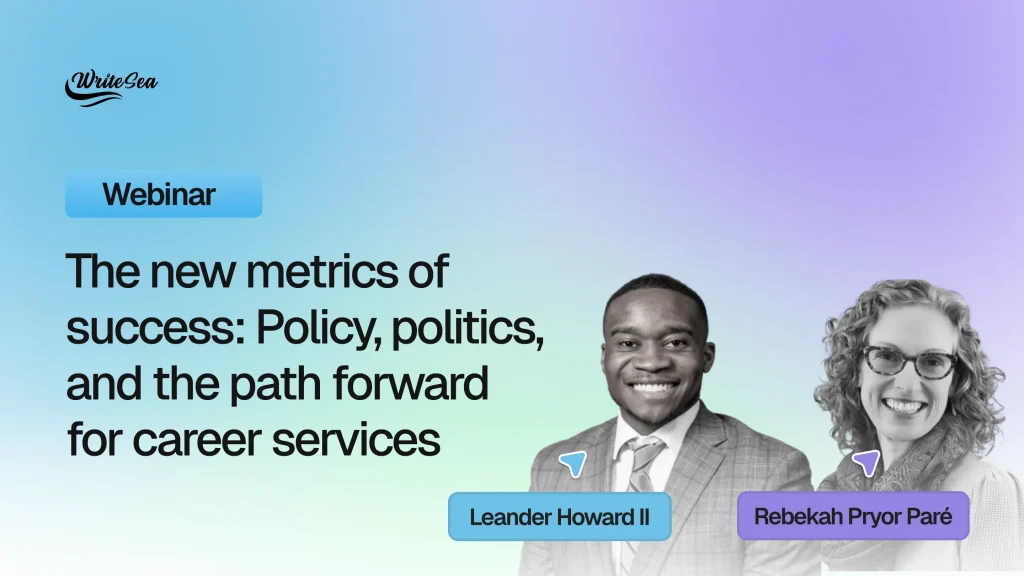
Our latest fireside chat, The New Metrics of Success: Policy, Politics, and the Path Forward for Career Services, brought together career leaders, faculty, and administrators navigating a rapidly shifting higher education landscape.
Featuring industry expert
Rebekah Paré and WriteSea’s
Leander Howard II, the session unpacked how national policy, state funding models, and rising student expectations are reshaping what success looks like — and why career services can no longer be seen as a “nice-to-have.”
Meet the Experts
🎙️ Rebekah Paré – Career Services Consultant & Strategy Coach
With over 20 years of experience in higher ed leadership, Rebekah has served at institutions like Washington University in St. Louis and the University of Wisconsin-Madison. She now consults with colleges globally to help elevate career services as a strategic function tied to student success, retention, and institutional relevance.
Leander Howard II is a career services industry expert, marketing strategist, and entrepreneur on a mission to revolutionize how job seekers land opportunities and how organizations enhance career services at scale. As the Co-Founder and Chief Marketing Officer of WriteSea, he leads the charge in integrating AI-powered career mobility solutions that help colleges and universities improve career outcomes and create structured hiring pathways.
Why Career Services Is Now a Policy Priority
The conversation opened with a hard truth: career services is no longer just a student issue — it’s an institutional one. With the rising cost of tuition and mounting student debt, families and legislators are demanding clear ROI.
As Rebekah noted:
“Career services is no longer a checkbox — it’s becoming a measure of institutional effectiveness.”
New federal and state policies are reinforcing that shift. Rebekah broke down how the recently passed Reconciliation Bill now ties program-level earnings data to federal accountability metrics. In short:
“If your graduates earn less than the median high school grad in your state, four years post-grad — your program could be in trouble.”
States like Tennessee, Florida, and Wisconsin are adding job placement and career outcomes to their performance-based funding models. And in Virginia, all public institutions are now required to implement work-based learning initiatives.
“It’s not just political pressure — it’s funding, rankings, and accreditation on the line.”
From Hidden Office to Strategic Driver: Reframing the Career Center
To stay relevant, career teams must shift the perception of their role on campus.
“Too many leaders still think of us as the resume and internship shop,” Rebekah said. “We have to reframe what we do in terms that resonate with them — enrollment, retention, student mental health, and institutional value.”
That starts by aligning your work with what campus leaders care about most. Whether it’s supporting first-gen students, building belonging, or improving graduation rates, career services has the data and stories to show impact — but that narrative has to be told intentionally.
Rebekah’s advice:
- Use soundbites your president could repeat to the board.
- Send short, strategic updates tied to institutional goals.
- Don’t just report “20 workshops held.” Ask, So what? What did those workshops accomplish?
Tools & Data That Make a Difference
“If 70% of your students don’t complete your first destination survey, that’s not just missing data — it’s a blind spot that leadership can’t afford.”
To boost response rates, some institutions now require completion to receive a diploma or partner with faculty to reserve class time for survey completion. Framing the survey as a way to give back to future students also helps increase participation.
Your Action Plan: 5 Ways to Lead with Strategy
If you’re ready to elevate your office — even without new headcount — here’s where to start:
- Map your work to top campus priorities (like enrollment, retention, accreditation, and mental health).
- Reframe your reports to show impact, not just activity.
- Gather and share stories that prove value (especially from employers and alumni).
- Collaborate cross-functionally — admissions, enrollment, marketing, and faculty are your allies.
- Say yes more than you say no — visibility often starts with being a reliable campus partner.
“If your office isn’t on fire, they’ll assume it’s fine. Sometimes you have to light the fire to get attention.” – Rebekah Paré
Ready to Go Deeper?
📰 Subscribe to Rebekah’s Career Strategy Newsletter
🎓 Explore WriteSea for Higher Education
📊 See how WriteSea is partnering with Stanford, Arizona State University (ASU), University of Southern California (USC), and more
🔗 Connect with Leander Howard II on LinkedIn
▶️ Watch our latest webinar: Mitigating Higher Ed Risk – The Power of Career Readiness Insights
Join The Write Way Newsletter
Gain access to a wealth of industry insights, news updates, and exclusive executive interviews from top leaders in the higher education and online recruitment marketplace industry.
 From the blog
The New Rules of Career Readiness in an AI Economy
Read the article
Hiring OS SoonConnect ready students with partner employers.
 From the blog
Why Every University Needs an Employability Strategy, Not Just a Career Center
Read the article