
Turn Career Fair Conversations Into Opportunities. Get the Career Fair Kit. Click here.
The Future of AI in Career Services: What’s Changing in 2025
Share this article
In this article


Introducing The Write Way: Your Weekly Career Innovation Digest
Join 1,000+ career services professionals who receive industry news, the latest trends, and insights on AI every single week straight to their inbox.
Career services in higher education are experiencing a profound shift. With enrollment pressures, budget constraints, and growing demands for proof of return on investment (ROI), leaders are under more scrutiny than ever. At the same time, artificial intelligence (AI) is transforming how students prepare for their careers, how employers recruit, and how universities demonstrate value.
In 2025, AI in career services is no longer experimental—it’s becoming essential. The challenge is not whether to adopt AI, but how to use it responsibly while keeping students at the heart of the process.
Why AI Matters in Career Services Today
Employers are reshaping hiring practices, demanding evidence of skills and readiness beyond a degree. The World Economic Forum (2025) notes that 44% of skills in current jobs are expected to change within the next five years, driven largely by AI and automation. This evolution creates both urgency and opportunity for higher education (World Economic Forum, 2025).
For career services, AI offers tools to:
- Provide AI resume review tools that mirror employer expectations.
- Deliver personalized career coaching AI to more students.
- Use predictive analytics for outcome tracking and ROI reporting.
- Engage students consistently through intelligent nudges and virtual advising.
WriteSea Pro Tip:
Frame AI not as a replacement for advisors, but as an amplifier of impact. Students still want empathy, guidance, and mentorship—AI makes it possible at scale.
The Key Trends Shaping 2025
1. Resume Reviews Go AI-First
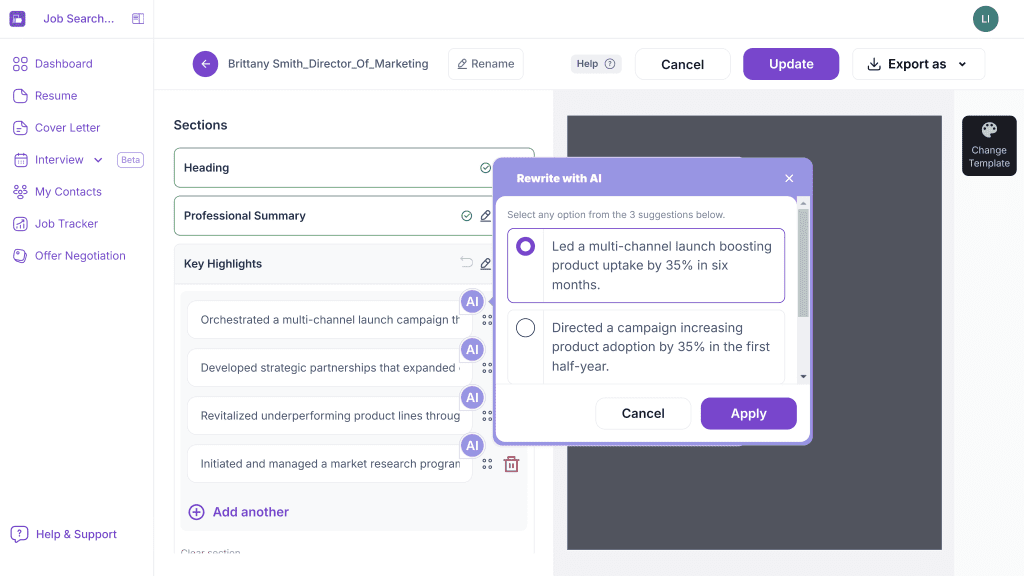
AI-driven resume review platforms are quickly becoming the norm. These tools analyze formatting, keyword use, and alignment with job descriptions, providing instant feedback for students. Importantly, they mimic the Applicant Tracking Systems (ATS) that most employers use, reducing the risk of resumes being filtered out (NACE, 2025a).
2. Career Coaching AI Broadens Access
Not every student books an appointment with a career advisor. AI chatbots and virtual coaching tools can bridge this gap, providing immediate answers to common questions, suggesting resources, and even simulating interview practice (Assembly Research Matters, 2025).
For first-generation students and adult learners balancing work and study, artificial intelligence in career counseling creates an accessible, 24/7 entry point to support.
WriteSea Pro Tip:
Use AI to lower the barrier of entry for students who feel nervous about asking for help. Normalizing AI coaching can lead to more in-person engagement later.
3. AI for Student Engagement and Belonging
AI isn’t just about job applications—it also helps students stay connected. Predictive analytics can identify disengaged learners, while intelligent nudges encourage participation in career fairs, internships, or workshops (FeedbackFruits, 2024).
This is especially critical in 2025, as retention and persistence rates remain fragile across higher education.
4. Outcome Transparency and ROI Proof
Universities are under pressure to prove ROI to prospective students, parents, and policymakers. AI for higher education career support allows institutions to track student journeys from enrollment through to employment, connecting coursework to real-world outcomes (PwC, 2025).
Transparent data builds trust—and gives leadership a way to demonstrate measurable impact in accreditation and rankings conversations.
Opportunities and Challenges of AI Adoption
Opportunities
- Scalability: Support thousands of students without proportional staffing increases.
- Personalization: Tailored career pathways for diverse learners.
- Efficiency: Automation of routine tasks frees staff for strategic work.
- Equity: Expands services to students historically underserved.
Challenges
- Bias Risks: Algorithms may replicate systemic inequities if left unchecked (TechTarget, 2023).
- Trust Issues: Students may fear losing human connection.
- Data Privacy: Career outcome dashboards must safeguard sensitive information.
- Cost Barriers: Upfront investment in AI infrastructure can be significant.
WriteSea Pro Tip:
Start small. A pilot project, such as AI resume feedback, can help staff build confidence and generate early success stories before scaling.
Ethical Guardrails for Responsible AI
To adopt AI responsibly, higher education must commit to three principles:
- Fairness: Regular audits of algorithms to reduce bias.
- Transparency: Clear communication when a student is interacting with AI vs. a human.
- Privacy: Strict governance for data handling and outcome reporting.
As higher ed institutions move forward, balancing innovation with accountability will be key (Springer, 2024; TechTarget, 2023).
FAQs
Will AI replace career advisors?
No. AI handles repetitive, time-consuming tasks so advisors can focus on deeper coaching, empathy, and strategy.
How can AI improve student engagement?
AI provides nudges, reminders, and personalized suggestions that keep students connected with resources and events—reducing attrition.
Is AI too expensive for smaller institutions?
Not necessarily. Many AI tools now integrate with existing platforms, and pilot projects can demonstrate ROI before large investments are made.
Conclusion: Building the Future Together
AI is reshaping the future of work, and higher education must adapt quickly. Institutions that integrate AI in career services responsibly will not only enhance student readiness but also strengthen their own credibility in a competitive enrollment market.
The next five years will be defined by leaders who use AI to expand access, personalize support, and prove measurable ROI—without losing the human connections that make career services essential.
WriteSea Pro Tip:
Future-proof your institution by embedding AI-driven tools into the student journey now. Explore how WriteSea for Higher Education can help streamline readiness and outcomes.
Book Your Free Demo
See how WriteSea can help your team re-engage students, track real outcomes, and automate outreach—without the manual lift.
Subscribe to The Write Way
Get weekly strategies, insights, and pro tips—so your team can stay ahead without burning out.
References
- Assembly Research Matters (2025) Reimagining career services using artificial intelligence. Available at: https://www.assemblyresearchmatters.org/2025/04/28/reimagining-career-services-using-artificial-intelligence/ (Accessed: 12 September 2025).
- FeedbackFruits (2024) Opportunities and challenges of AI in higher education. Available at: https://feedbackfruits.com/blog/opportunities-and-challenges-of-ai-in-higher-education (Accessed: 12 September 2025).
- National Association of Colleges and Employers (NACE) (2025a) The attributes employers look for on new grad resumes—and how to showcase them. Available at: https://www.naceweb.org/about-us/press/the-attributes-employers-look-for-on-new-grad-resumes-and-how-to-showcase-them (Accessed: 12 September 2025).
- PwC (2025) AI job barometer 2025. Available at: https://www.pwc.com/gx/en/issues/artificial-intelligence/job-barometer/2025/report.pdf (Accessed: 12 September 2025).
- Springer (2024) AI in higher education: Opportunities and risks. Journal of Innovation and Entrepreneurship. Available at: https://link.springer.com/article/10.1007/s11846-024-00789-3 (Accessed: 12 September 2025).
- TechTarget (2023) Generative AI ethics: 8 biggest concerns. Available at: https://www.techtarget.com/searchenterpriseai/tip/Generative-AI-ethics-8-biggest-concerns (Accessed: 12 September 2025).
- World Economic Forum (2025) The Future of Jobs Report 2025. Available at: https://www.weforum.org/publications/the-future-of-jobs-report-2025/digest/ (Accessed: 12 September 2025).

Leander Howard II
Leander Howard II is the Co-Founder and Chief Marketing Officer at WriteSea, an AI-powered career services platform transforming how students and job seekers navigate their professional journey. With a background in marketing, finance, and career coaching, Leander brings a unique blend of industry insight and entrepreneurial drive to the higher education space. He’s a passionate advocate for equitable access to career readiness tools and believes career support should be embedded across every student touchpoint. A Georgia State University alumnus, Leander is based in Tulsa, Oklahoma. Outside of work, he enjoys podcasting, running, and spending time with family and friends.