Introduction
In this special
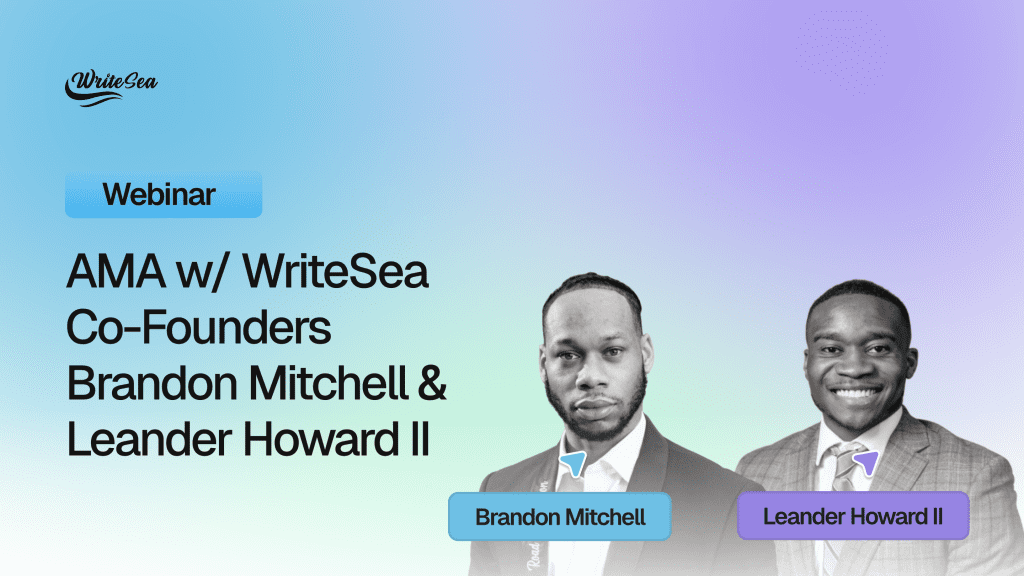
Ask Me Anything (AMA) session, WriteSea co-founders
Brandon Mitchell (CEO) and
Leander Howard II (CMO) fielded candid questions from career leaders, faculty, and administrators. The focus:
how to scale high-quality support 24/7, free staff to do more strategic advising, and prove outcomes in a tougher job market. From integrations and onboarding to mock interviews, salary conversations, and analytics, nothing was off-limits—and the audience Q&A revealed what campuses need right now.
🎥 Missed it live?
Watch the recording .
Meet the Experts
🔹 Brandon Mitchell, PMP, CSM – Co-Founder & CEO, WriteSea – Brandon Mitchell is a technology entrepreneur and executive coach dedicated to transforming how individuals and institutions achieve career success. As the Co-Founder and Chief Executive Officer of WriteSea, he has worked with thousands of job seekers, trained career coaches to scale their businesses, and guided institutions in adopting tech-enabled career services. A former consultant at PricewaterhouseCoopers, he has advised leading financial institutions including KKR, Deutsche Bank, and Morgan Stanley. Featured in Forbes, Yahoo Finance, and Earn Your Leisure, Brandon also speaks regularly on financial literacy and generational wealth.
🔹 Leander Howard II – Co-Founder & CMO, WriteSea – Leander Howard II is a career services industry expert, marketing strategist, and entrepreneur on a mission to revolutionize how job seekers land opportunities and how organizations enhance career services at scale. As the Co-Founder and Chief Marketing Officer of WriteSea, he leads the charge in integrating AI-powered career mobility solutions that help colleges and universities improve career outcomes and create structured hiring pathways.
What’s Driving the Conversation
Attendees framed the challenge clearly: students need easier access and better prep, while presidents want proof of outcomes. Pandemic-era disruptions and a tighter job market accelerated the need for always-on tools and data leaders can trust.
“The leap is going from tactical tasks to strategic advising—and the data makes that possible.” – Brandon Mitchell
Poll responses echoed the pain points: student engagement, tracking outcomes, employer connections, and time constraints when proving ROI to leadership.
Shifting the Narrative on Campus
A recurring AMA theme was reclaiming staff time. Instead of spending hours on bullet-point edits and ad-hoc practice interviews, teams can offload tactical work to software and invest their limited time in coaching strategy, alumni networking, and job-search road-mapping.
“Don’t start at zero. If a student already simulated two interviews, jump straight to strategy.” – Brandon Mitchell
“When you can show scores improving semester-to-semester, leadership leans in.” – Leander Howard II
The panel also emphasized messaging: report activity, but tell the outcome story—activation rates, interview scores, and readiness signals by cohort. Tie updates to institutional goals like enrollment, retention, equity, and mental health.
Tools, Data & Policy You Can’t Ignore
All-in-one matters. Brandon and Leander contrasted today’s fragmented stacks (6–7 tools, multiple logins) with a single system that brings the journey together:
- Resume builder + AI rewrites that probe for impact: students get structured, achievement-based bullets (with follow-up questions) instead of vague duties.
- Cover letters in seconds: pull from the resume + job description, adjust tone/length, and move on.
- Job feed + job tracker: surface matched roles, track applications across sites, and keep everything in one place.
- Mock interviews that adapt to resume + job + interview type + difficulty, providing scores and question-by-question feedback.
- Custom, canned question sets for programs (e.g., salary conversations, law, admissions)—a feature co-created with partners so schools can standardize readiness.
- Salary negotiation assistant: analyze an offer and generate talking points and scripts (comp, PTO, schedule, benefits).
- Personal CRM for every student: track contacts, follow-ups, and networking actions—critical for first-gen and transfer students.
On the staff side:
- Admin analytics give real-time visibility: who’s active, who’s simulating interviews, who’s building resumes/cover letters—by class year, major, or engagement level.
- APIs + SIS blending let institutions pair product data with demographics/BI tools to tell a coherent, semester-over-semester story.
- Integrations: Handshake (use postings and simulate on top), 12twenty (deeper API-key features), and uConnect embeds.
- Onboarding: SSO in 1–2 days; two 1-hour trainings for staff; marketing support for activation (graphics, newsletter copy, nudges).
- Co-creation: Features are shaped with partners (e.g., Tulsa Community College helped pioneer custom interview sets; Oakton College co-created a 1-credit AI Job Search Skills course embedding career prep directly into the curriculum).
“We joke that we’re building a data-tracking tool for career readiness. If you can’t measure it across semesters, it’s hard to fund, scale, or improve.” – Brandon Mitchell
Audience Q&A Highlights
Your Action Plan: 5 Ways to Move Forward
- Shift the center of gravity: Let software handle the tactical; use appointments for strategy (network mapping, employer intros, narrative coaching).
- Instrument readiness: Track interview scores, usage, and activation by cohort; report improvements term-over-term.
- Standardize practice: Create program-specific question banks (salary, admissions, licensure-related scenarios) to reduce variability and lift baselines.
- Blend your data: Connect product data to SIS/BI so leadership can see who’s improving, where, and why.
- Plan engagement like a campaign: Set SSO, activation targets, nudges, faculty partners, and class-time checkpoints before launch.
Vision & What’s Next
Brandon closed the AMA with a look ahead: 100–150 institutional partners, a stronger focus on skills-forward pathways, and continuous innovation on engagement.
“The most important skill for students is the ability to learn. If we can help them practice that—through AI tools, upskilling pathways, and measurable outcomes—they’ll be better prepared for whatever the job market throws at them.” – Brandon Mitchell
The roadmap centers on:
- Scaling engagement: ambassador programs, activation goals, and faculty partnerships.
- Innovating features: new ways to blend AI into resumes, interviews, and advising workflows.
- Expanding outcomes: from undergrads to alumni, institutions want tools that support lifelong career readiness.
The goal: make it simple for institutions to tell a compelling outcome story and for students to land more interviews—faster.
Want to Go Deeper?
📩 Subscribe to the WriteSea Newsletter
Stay ahead with weekly insights on ROI, student readiness, and leadership strategy.
🎓 Explore WriteSea for Higher Education
See how our all-in-one platform helps institutions prove ROI, track outcomes, and free staff for strategic advising.
📊 See how WriteSea partners with institutions like Tulsa Community College & Oakton College
From co-creating AI job search courses to customizing interview prep, learn how campuses are shaping student success with WriteSea.
🔗 Connect with Brandon Mitchell (CEO) on LinkedIn
Read insights on career readiness, enrollment, and institutional strategy.
🔗 Connect with Leander Howard II (CMO) on LinkedIn
Explore his journey building the future of career services and AI-driven support.
▶️ Watch our latest webinar: The New Metrics of Success – Policy, Politics & the Future of Career Services
Join Rebekah Paré and Leander Howard II as they unpack how shifting policies, funding models, and rising student expectations are reshaping what success looks like—and why career services can no longer be seen as a “nice-to-have.”
Join The Write Way Newsletter
Gain access to a wealth of industry insights, news updates, and exclusive executive interviews from top leaders in the higher education and online recruitment marketplace industry.
 From the blog
The New Rules of Career Readiness in an AI Economy
Read the article
Hiring OS SoonConnect ready students with partner employers.
 From the blog
Why Every University Needs an Employability Strategy, Not Just a Career Center
Read the article