Turn Career Fair Conversations Into Opportunities. Get the Career Fair Kit. Click here.
Why Career Readiness Needs to Start Before Junior Year
Share this article
In this article


Introducing The Write Way: Your Weekly Career Innovation Digest
Join 1,000+ career services professionals who receive industry news, the latest trends, and insights on AI every single week straight to their inbox.
In many institutions, career readiness support begins only in junior or senior year. But by that point, students have already chosen majors, started internships, and often feel locked into paths that may not fit.
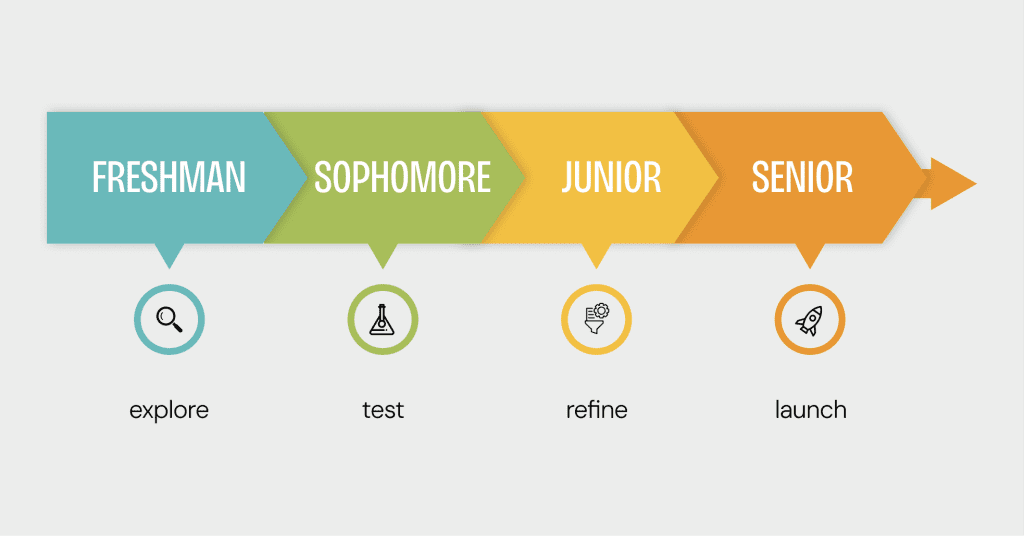
To create sustainable and equitable student outcomes, career readiness must begin much earlier—during freshman and sophomore years. Early exposure helps students explore interests, build essential skills, and connect classroom learning to meaningful work.
This blog explores why early career readiness matters in 2025, how to engage first- and second-year students, and how tools like WriteSea help automate early outreach at scale.
1. The Problem with Late-Stage Career Support
Too Little Time to Pivot
By junior year, many students have committed to majors. Changing direction late in the journey can delay graduation and add financial strain.
Reactive vs. Proactive Engagement
Career centers often see a surge of traffic in the final year, while freshmen and sophomores rarely visit. Without early engagement, students miss chances to connect coursework with career paths.
Workforce Expectations Are Changing
Employers increasingly expect graduates to demonstrate career readiness competencies such as communication, critical thinking, teamwork, and professionalism (NACE, 2024). These competencies take time to develop—years, not months.
Higher Ed in 2025
With enrollment on the decline and ROI under scrutiny, institutions must demonstrate measurable outcomes. Waiting until junior year is no longer viable (OECD, 2021).
WriteSea Pro Tip:
Map your institution’s “career engagement funnel.” Where do most students start engaging—junior year? Senior? Reverse-engineer strategies to reach them two years earlier.
2. The Benefits of Early Career Exploration

Starting early builds confidence, self-awareness, and persistence. It also distributes workload across years—reducing burnout for both students and staff.
More Time to Explore and Adjust
Early exploration lets students try multiple options, reflect, and refine their goals before major academic or financial decisions.
Higher Motivation and Retention
Students who connect studies to real-world purpose persist longer and perform better (ASA, 2023).
Equity and Access
Underrepresented and first-generation students often lack career networks. Early support helps bridge that gap, ensuring equitable access to opportunity (AMLE, n.d.).
Institutional Advantage
Colleges that embed early readiness report stronger satisfaction and employability outcomes—key differentiators in 2025’s competitive landscape (Forbes, Manno, 2024).
3. Strategies for First- and Second-Year Engagement

These approaches make freshman career prep scalable and meaningful.
3.1 Onboarding with Career Identity
- Integrate short “career foundation” modules in freshman orientation or first-year experience courses.
- Use personality and values assessments to help students understand what drives them.
- Facilitate mini workshops on “Defining My Why.”
3.2 Exposure Through Micro-Experiences
- Invite guest speakers or alumni for short “day-in-the-life” sessions.
- Offer micro-internships, job shadowing, or volunteering opportunities.
- Encourage reflection journals to connect experiences to goals (Forbes, Gandal, 2024).
3.3 Curriculum Integration
- Label assignments with NACE competencies (NACE, 2024).
- Add reflection prompts linking academic work to workplace relevance.
- Encourage early-year faculty to embed “career-thinking” discussions in core classes.
3.4 Peer Mentorship & Communities
Peer mentoring builds psychological safety and shared learning. Create small peer pods where upperclass students guide freshmen.
3.5 Automated Nudges & Digital Outreach
Automate milestone reminders—like monthly “career reflections” or interest surveys—to keep students engaged consistently.
WriteSea Pro Tip:
Use WriteSea to automate these touchpoints. Schedule nudges and segment outreach by student type—STEM, business, liberal arts—to deliver the right message at the right time.
4. Partnering with Faculty for Early Touchpoints

Faculty shape how students perceive career relevance. Collaboration ensures consistency and scalability.
Faculty Development
Host workshops on embedding career competencies in assignments. Provide ready-to-use templates and NACE framework cheat sheets.
Syllabus Integration
Add icons or color cues in syllabi Add icons or color cues in syllabi to identify skill-building assignments (University of South Alabama, n.d.)
Collaborative Learning
Invite faculty to co-lead career discussions, panels, or applied learning sessions.
WriteSea Pro Tip:
Create a shared “Career Integration Tracker” where faculty log courses linked to readiness outcomes—then visualize gaps using WriteSea’s analytics.
5. Scale Early Career Readiness with Smart Automation
Preparing students for the workforce shouldn’t require more staff hours—it requires better systems.
With WriteSea’s AI-powered career readiness platform, your institution can:
- Automate outreach to first-year students and guide them through early exploration.
- Deliver personalized self-assessments and reflection prompts that build self-awareness.
- Track engagement by major, department, or demographic group with real-time insights.
- Give admins and faculty access to intuitive analytics dashboards that drive data-informed decisions.
Automation keeps students consistently engaged—while freeing your team to focus on the personal mentoring that matters most.
Final Thoughts
Career readiness isn’t a last-minute sprint—it’s a developmental journey. By embedding early career readiness strategies—faculty partnerships, micro-learning, and automated outreach—institutions can create a culture of continuous exploration and equity.
If you’re ready to scale early outreach and measurable outcomes, explore how WriteSea’s AI-powered career readiness platform can help your team implement automated engagement and analytics across all student cohorts.
FAQs
Isn’t freshman year too early for career prep?
No—early exposure is about self-awareness, not locking in a major. It gives students time to test and reflect.
How can colleges prevent burnout or overwhelm?
Start small. Replace long workshops with 10-minute reflections, short digital check-ins, or automated resources.
How can progress be measured?
Track metrics like event attendance, self-assessment completion, and early internship interest. Tie engagement to retention and graduate outcomes.
Book Your Free Demo
See how WriteSea can help your team re-engage students, track real outcomes, and automate outreach—without the manual lift.
Subscribe to The Write Way
Get weekly strategies, insights, and pro tips—so your team can stay ahead without burning out.
References
- American Student Assistance (ASA). (2023). High school is too late to start the career conversation. Available at: https://www.asa.org/research/high-school-is-too-late-to-start-the-career-conversation/ (Accessed: 14 October 2025).
- AMLE. (n.d.). Future readiness means allowing learners to explore, test, and try career options earlier on. Available at: https://www.amle.org/future-readiness-means-allowing-learners-to-explore-test-and-try-career-options-earlier-on/ (Accessed: 14 October 2025).
- Forbes. Gandal, M. (2024, March 14). The case for starting career exploration as early as middle school. Available at: https://www.forbes.com/sites/mattgandal/2024/03/14/the-case-for-starting-career-exploration-as-early-as-middle-school/ (Accessed: 14 October 2025).
- Forbes. Manno, B. (2024, December 10). A virtuous cycle of career education for young people. Available at: https://www.forbes.com/sites/brunomanno/2024/12/10/a-virtuous-cycle-of-career-education-for-young-people/ (Accessed: 14 October 2025).
- National Association of Colleges and Employers (NACE). (2024). Career readiness defined. Available at: https://www.naceweb.org/career-readiness/competencies/career-readiness-defined (Accessed: 14 October 2025).
- National Association of Colleges and Employers (NACE). (2022). Development and validation of the NACE career readiness competencies. Available at: https://www.naceweb.org/uploadedFiles/files/2022/resources/2022-nace-career-readiness-development-and-validation.pdf (Accessed: 14 October 2025).
- OECD. (2021). Indicators of teenage career readiness. Available at: https://www.oecd.org/content/dam/oecd/en/publications/reports/2021/10/indicators-of-teenage-career-readiness_05e75f6e/cec854f8-en.pdf (Accessed: 14 October 2025).
- University of South Alabama. (n.d.). NACE Career Readiness Competencies. Available at: https://www.southalabama.edu/departments/academicenhancement/levelup/nace-career-readiness.html (Accessed: 14 October 2025).

Leander Howard II
Leander Howard II is the Co-Founder and Chief Marketing Officer at WriteSea, an AI-powered career services platform transforming how students and job seekers navigate their professional journey. With a background in marketing, finance, and career coaching, Leander brings a unique blend of industry insight and entrepreneurial drive to the higher education space. He’s a passionate advocate for equitable access to career readiness tools and believes career support should be embedded across every student touchpoint. A Georgia State University alumnus, Leander is based in Tulsa, Oklahoma. Outside of work, he enjoys podcasting, running, and spending time with family and friends.