
The Hidden Cost of Low Career Services Engagement
Share this article
In this article


Introducing The Write Way: Your Weekly Career Innovation Digest
Join 1,000+ career services professionals who receive industry news, the latest trends, and insights on AI every single week straight to their inbox.

Universities are investing heavily in career readiness initiatives.
Career centers continue expanding programming.
Institutions introduce new platforms and tools.
Employer partnerships grow.
Student success strategies evolve.
Yet many students still never meaningfully engage with career services at all.
And when engagement remains low, the consequences extend far beyond workshop attendance or appointment numbers.
It impacts:
- student preparedness
- workforce outcomes
- institutional visibility
- return on investment
- long-term student success
The problem is often not that institutions lack career resources.
It is that too many students never meaningfully encounter those resources early enough for them to shape long-term outcomes.
Research from the National Association of Colleges and Employers (NACE) shows that students who engage with career services are more likely to receive job offers and report stronger employment outcomes after graduation.
At the same time, student engagement with career centers remains inconsistent across many institutions.
According to Inside Higher Ed, large numbers of students either engage very late with career services or do not engage at all during college.
As higher education faces increasing pressure around workforce readiness, graduate outcomes, and institutional value, low career services engagement is becoming more than an operational challenge.
It is becoming a strategic institutional risk.
Why Career Services Engagement Remains Low

Most students are not intentionally avoiding career support.
More often, engagement breaks down because traditional career services models still depend heavily on student initiative.
Students are expected to:
- independently seek out support
- understand what services exist
- recognize when they need help
- proactively schedule appointments
- consistently engage over time
But many students, especially in their early years, are still navigating:
- identity
- belonging
- academic pressure
- uncertainty about career direction
- unfamiliar institutional systems
As a result, career readiness often becomes reactive instead of proactive.
Students wait until:
- internship deadlines approach
- graduation nears
- job searching becomes urgent
The challenge becomes even greater at scale.
Career centers are often balancing:
- growing student populations
- limited staffing
- increasing pressure to demonstrate outcomes
- demand for more personalized support
Research highlighted by Inside Higher Ed found that only 17% of students used career services for internship support, while only 12% engaged with mock interview preparation services.
That gap matters.
Because career readiness cannot create institutional impact if students engage too late for support to meaningfully shape outcomes.
WriteSea Pro Tip:
If career readiness depends entirely on students proactively finding support themselves, many students will engage too late for institutions to create measurable long-term impact at scale.
The Impact Low Engagement Has on Student Outcomes
Low career services engagement affects far more than participation metrics.
It can directly influence how prepared students feel when transitioning into internships, interviews, and the workforce.
Students who engage later often experience:
- rushed resume preparation
- limited networking exposure
- lower confidence in professional settings
- reduced awareness of career pathways
- reactive job searching
These gaps compound over time.
The earlier students begin building career readiness skills, the more opportunity they have to:
- explore interests
- refine goals
- build professional confidence
- gain practical experience gradually
Research from NACE – The Value of Career Services found that students who used career services received more job offers on average than students who did not engage.
Low engagement also creates equity concerns.
Students who already possess strong professional networks or career knowledge may navigate opportunities more independently.
Students without that exposure often depend more heavily on institutional guidance.
When engagement remains inconsistent, access to career readiness can unintentionally become uneven across the student population.
This is one reason institutions are increasingly exploring ways to embed career readiness directly into the broader student experience instead of relying solely on optional participation models.
The Institutional Risks Universities Often Overlook
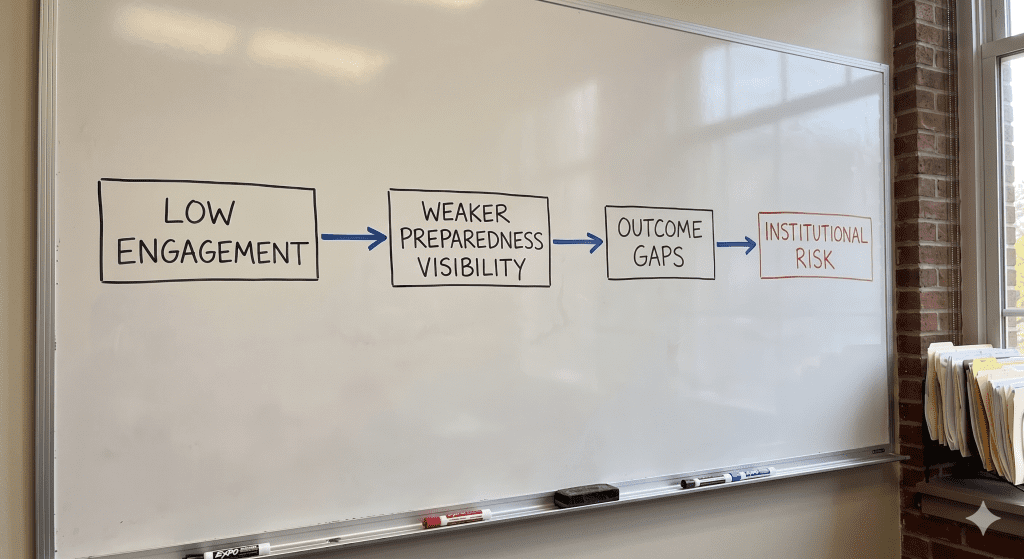
Low career services engagement is not only a student support issue.
It increasingly affects institutional strategy.
As higher education faces growing scrutiny around value, employability, and workforce outcomes, institutions are under pressure to demonstrate:
- student preparedness
- graduate success
- workforce alignment
- long-term ROI
- career readiness outcomes
When large portions of the student population remain disconnected from career support, institutions lose visibility into readiness progression across the student lifecycle.
That creates challenges around:
- identifying engagement gaps
- scaling support effectively
- measuring institutional impact
- demonstrating the value of career readiness investments
The issue becomes even more important as enrollment pressures continue shaping higher education strategy.
Students and families are increasingly evaluating colleges and universities based not only on academic reputation, but also on career outcomes and long-term opportunity.
The Strada State Opportunity Index highlights how students increasingly prioritize quality coaching, career guidance, and pathways into employment when evaluating educational value.
Low engagement can also create reputational risk over time if institutions struggle to connect students with meaningful workforce preparation and career outcomes.
The Hidden ROI Problem
Many institutions are already investing significant resources into career readiness initiatives.
This includes investments in:
- staffing
- employer partnerships
- career technology
- workshops
- advising
- programming
- student success initiatives
But when student engagement remains low, demonstrating the return on those investments becomes significantly harder.
Institutions may offer excellent resources while still struggling to answer important leadership questions:
- How many students are actually engaging consistently?
- Which interventions are improving preparedness?
- Where are engagement gaps occurring?
- Which students are being missed?
- What impact are career readiness initiatives having over time?
This is where low engagement becomes more than a participation issue.
It becomes a visibility issue.
Without broad engagement across the student population, institutions often struggle to connect career readiness investments to measurable institutional outcomes.
That challenge is becoming increasingly important as leadership teams seek clearer reporting around:
- retention
- engagement
- workforce readiness
- graduate success
- student ROI
The institutions seeing the strongest outcomes are often not the ones offering the most services.
They are the ones students consistently engage with throughout their academic journey.
Why Traditional Engagement Models Are Struggling
Traditional career services models were not originally built for today’s scale, expectations, or workforce environment.
Many still rely heavily on:
- appointment-based support
- optional workshop attendance
- fragmented communication
- manual advising capacity
- students independently seeking help
But modern students increasingly expect support to feel:
- accessible
- integrated
- personalized
- proactive
- available earlier
At the same time, career services teams are being asked to support more students with limited additional staffing.
This creates a scalability challenge.
The institutions improving engagement most effectively are often the ones reducing friction between students and career support systems.
Instead of waiting for students to opt in late, career readiness becomes embedded into:
- coursework
- first-year experiences
- advising systems
- digital student journeys
- ongoing engagement touchpoints
The goal shifts from:
“Making services available.”
To:
“Making engagement easier and more consistent.”
What Higher-Engagement Career Ecosystems Look Like
Higher-engagement career ecosystems are typically proactive rather than reactive.
They introduce career readiness earlier.
They reduce barriers to participation.
And they integrate support across the student journey instead of isolating it within one office.
This can include:
- first-year career readiness programming
- embedded resume support
- AI-powered mock interviews
- integrated advising workflows
- career exploration within coursework
- digital engagement tools
- scalable readiness assessments
- ongoing student engagement tracking
The NACE – Designing the Future of Career Services highlights how institutions are increasingly moving toward more connected, scalable, and technology-enabled career readiness models.
The strongest engagement ecosystems are not necessarily the ones offering the most programs.
They are the ones students consistently interact with throughout their academic journey.
Where WriteSea Fits In
Career readiness becomes significantly more effective when engagement is easier, earlier, and more consistent.
That is why many institutions are beginning to rethink how career support is delivered across the student experience.
WriteSea helps institutions create more scalable and accessible career readiness experiences by reducing friction between students and support systems.
Instead of relying entirely on students to proactively seek help late in their academic journey, institutions can introduce career readiness earlier through:
- resume-building support
- AI-powered mock interviews
- professional communication practice
- career exploration tools
- embedded readiness experiences
This helps institutions:
- increase engagement
- standardize readiness experiences
- support more students at scale
- improve visibility into student preparedness
- reduce manual workload for staff
- strengthen long-term workforce outcomes
WriteSea can support:
- first-year experience programs
- advising initiatives
- student success strategies
- career readiness coursework
- workforce development initiatives
WriteSea Pro Tip:
The institutions seeing the strongest outcomes are often not the ones offering the most services. They are the ones making career readiness easier for students to engage with consistently.
Final Thought
Low career services engagement is easy to dismiss as a participation issue.
But its long-term impact reaches much further.
It affects preparedness.
Visibility into outcomes.
Institutional ROI.
And ultimately, how effectively universities help students connect education to opportunity.
The institutions leading in workforce readiness are increasingly moving beyond reactive engagement models.
They are building systems that reach students earlier, reduce barriers to participation, and make career readiness part of the broader student experience itself.
Because career support only creates meaningful impact when students actually engage with it.
FAQs
Why do many students avoid career services?
Many students delay engagement because career services often rely heavily on students proactively seeking support themselves. Others may not fully understand what resources exist or may wait until career decisions become urgent.
How does low career services engagement affect student outcomes?
Low engagement can lead to delayed career planning, weaker interview readiness, reduced networking opportunities, and lower confidence during the transition into internships or full-time employment.
What are the institutional risks of low career services engagement?
Institutions may face challenges around demonstrating student outcomes, workforce readiness, return on investment, and long-term graduate preparedness when engagement remains inconsistent.
How can universities improve career services engagement?
Many institutions are improving engagement by embedding career readiness into first-year programs, advising systems, coursework, and scalable digital experiences.
What role does AI play in career readiness engagement?
AI-powered career readiness tools can help institutions scale resume support, mock interviews, career exploration, and personalized guidance across larger student populations.
Book Your Free Demo
See how WriteSea helps your team measure career outcomes, identify risk early, and improve engagement without the manual lift.
Subscribe to The Write Way
Get weekly strategies, insights, and pro tips on career readiness, outcomes measurement, and scalable systems for higher ed teams.
References
- National Association of Colleges and Employers. “The Value of Career Services.” https://www.naceweb.org/career-development/organizational-structure/the-value-of-career-services/
- National Association of Colleges and Employers. “Designing the Future of Career Services.” https://www.naceweb.org/career-development/trends-and-predictions/designing-the-future-of-career-services
- Inside Higher Ed. “What College Students Want From Career Services.” https://www.insidehighered.com/news/student-success/life-after-college/2023/11/30/survey-what-college-students-want-career
- World Economic Forum. “Future of Jobs Report 2025.” https://www.weforum.org/reports/the-future-of-jobs-report-2025/
- Strada Education Foundation. “State Opportunity Index.” https://www.strada.org/state-opportunity-index/

Brandon Mitchell
Brandon Mitchell is the Founder and CEO of WriteSea, an AI-powered career services platform that helps educational institutions and workforce development offices improve the job seeker experience. He has over eight years of experience helping job seekers and organizations leverage technology for career mobility, and previously worked as a technology consultant at PwC. Brandon has been featured in Yahoo Finance, Forbes, and other outlets for his work in career development, technology, and entrepreneurship. Brandon is based in Tulsa, and enjoys hosting on Airbnb, traveling, and pickleball.