Introduction
As colleges and universities face growing pressure to improve graduate outcomes, strengthen employer partnerships, and better prepare students for an evolving workforce, many institutions are rethinking how career services fits into the bigger picture.
Rather than operating as separate functions, career services and workforce development are increasingly being viewed as complementary strategies for supporting student success and meeting workforce needs.
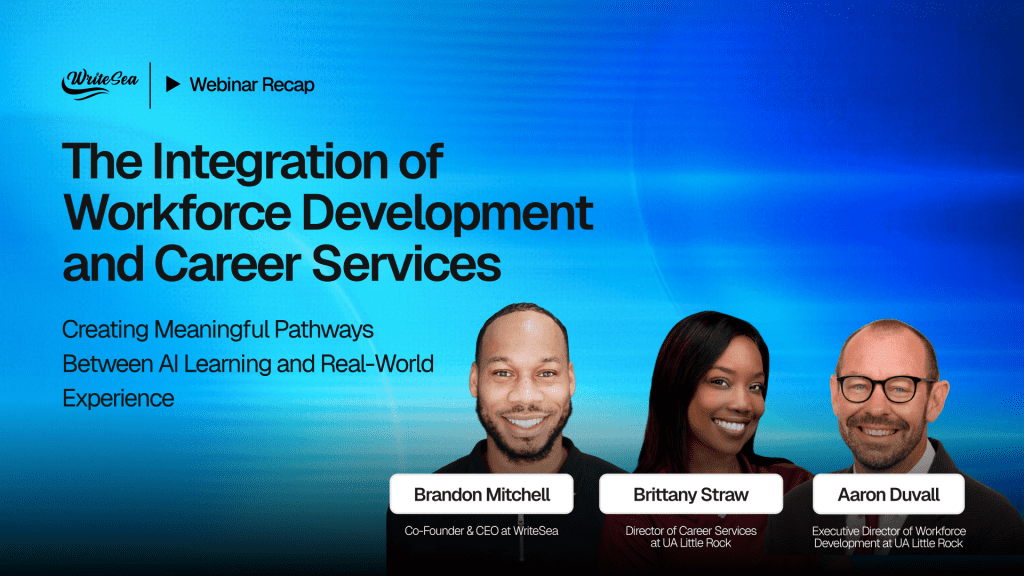
Together, they explored how integrating workforce development and career services can strengthen employer partnerships, improve collaboration across campus, and create more connected pathways from education to employment.
As Brandon noted during the discussion:
“The workforce of yesterday is not the workforce of today.”
— Brandon Mitchell, Co-Founder & CEO, WriteSea
That shift requires institutions to think differently about how they prepare students—not just as they approach graduation, but throughout their entire educational journey.
Whether you’re a career services leader, workforce development professional, academic administrator, or institutional leader, this conversation offers practical strategies for building stronger campus partnerships and improving career outcomes for students.
🎥 Missed it live?
Watch the recording .
Meet the Experts
🔹 Dr. Aaron Duvall — Executive Director of Workforce Development, University of Arkansas at Little Rock
Aaron Duvall is passionate about helping students discover life-changing opportunities through innovative workforce programs and competency-based learning. As Executive Director of Workforce Development at UA Little Rock, he leads Corporate and Community Education, Study Abroad, University Career Services, and Concurrent Enrollment.
With more than 20 years of educational experience as a teacher, coach, and administrator in higher education, public, private, and charter schools, Aaron has dedicated his career to creating pathways for student success.
He earned his Ed.D. in Rural and Culturally Diverse Education from Southern Arkansas University, has contributed to statewide education policy initiatives, and regularly presents and publishes on workforce development, CTE, and leadership. Aaron lives in Conway, Arkansas with his wife and three children.
🔹 Brittany Straw — Director of Career Services, University of Arkansas at Little Rock
Brittany Straw is passionate about helping students build the confidence, skills, and connections they need to succeed after graduation. As Director of Career Services at the University of Arkansas at Little Rock, she leads initiatives that strengthen employer partnerships, expand experiential learning opportunities, and enhance career readiness across campus.
With nearly 20 years of experience in higher education, Brittany has served in leadership roles across career services, career education, and student success. She has developed innovative career readiness programs, taught university courses, and regularly presents at regional and national conferences on career development, workforce readiness, and leadership.
Brittany is an active member of the National Association of Colleges and Employers (NACE), the Southern Association of Colleges and Employers (SoACE), and the Arkansas Association of Colleges and Employers (AACE). She is a Global Career Development Facilitator and is committed to advancing student success through collaboration, innovation, and meaningful employer partnerships.
🔹 Brandon Mitchell — Co-Founder & CEO, WriteSea
Brandon Mitchell is a technology entrepreneur, executive coach, and investor, dedicated to revolutionizing the career services and recruitment industry. As the Co-Founder & CEO of WriteSea, he is driving innovation in AI-powered career mobility solutions, helping job seekers and employers connect more effectively.
With a background in technology consulting at PricewaterhouseCoopers (PwC), Brandon has advised Fortune 500 companies, including KKR, Deutsche Bank, and Morgan Stanley, on complex technology and wealth management solutions. His expertise spans SaaS sales, executive leadership, and public speaking.
Brandon has been featured in Forbes, Yahoo Finance, Earn Your Leisure, and Black Wealth Renaissance. He is also a passionate advocate for financial literacy, career development, and generational wealth, frequently speaking on these topics.
He holds a degree in Finance, Economics, and Management Information Systems from SUNY Plattsburgh and is certified in project management and agile methodologies.
Why Career Services and Workforce Development Are Better Together
For many colleges and universities, career services and workforce development have traditionally operated as separate functions. While both share the goal of preparing students for successful careers, they have often worked independently, with different priorities, reporting structures, and resources.
That is beginning to change.
As institutions face increasing pressure to improve graduate outcomes, demonstrate return on investment, and respond to rapidly evolving workforce needs, more universities are exploring how these functions can work together to create a seamless student-to-career pipeline.
For the University of Arkansas at Little Rock, this integration wasn’t simply about restructuring departments. It was about creating a more connected approach to student success.
Brittany Straw explained that bringing workforce development and career services together allows the institution to think beyond graduation and instead build career readiness throughout the entire learner journey.
“By creating a workforce development center, you’re showing the initiative to create a pipeline… from students that are in high school all the way to lifelong learning. We’re also building those career readiness concepts at every stage.”
— Brittany Straw, Director of Career Services, University of Arkansas at Little Rock
Rather than viewing career development as a service students access near graduation, the discussion highlighted the importance of embedding career readiness throughout a student’s educational experience—from recruitment and enrollment through to employment and lifelong learning.
Dr. Aaron Duvall noted that this shift is becoming more common across higher education, with career services increasingly moving under workforce development or closely aligning with institutional workforce initiatives.
For him, the greatest advantage isn’t simply organisational alignment—it’s shared purpose.
“You become a force multiplier when you have multiple people, multiple organizations or departments on a campus that are aimed at the same mission.”
— Dr. Aaron Duvall, Executive Director of Workforce Development, University of Arkansas at Little Rock
Instead of multiple departments working toward similar goals independently, institutions have an opportunity to combine expertise, share resources, strengthen employer relationships, and create a more coordinated student experience.
Throughout the discussion, one message became clear: integrating workforce development and career services isn’t about changing organisational charts. It’s about creating stronger partnerships across campus that ultimately lead to better outcomes for students, employers, and the institution as a whole.
Building a Campus-Wide Culture of Career Readiness
Integrating workforce development and career services is about more than bringing departments under the same reporting structure. Lasting success depends on creating a shared vision across the institution—one where career readiness is seen as a responsibility that extends beyond a single office.
At the University of Arkansas at Little Rock, this shift began with institutional leadership.
Dr. Aaron Duvall explained that the move toward a more integrated model was driven by a university initiative focused on strengthening collaboration and making better use of existing resources.
“This really came from the university… the Provost initiative.”
— Dr. Aaron Duvall, Executive Director of Workforce Development, University of Arkansas at Little Rock
Rather than creating another standalone initiative, the goal was to align existing efforts under a common mission. Career services, workforce development, academic affairs, and other campus partners each had expertise to contribute, but greater collaboration would allow them to achieve more together than they could independently.
Brandon Mitchell noted that this shift is not unique to one institution. Across higher education, WriteSea is seeing career services evolve in different ways, with some institutions aligning the function more closely with workforce development, while others are placing it under enrollment management to strengthen the connection between recruitment, student success, and career outcomes.
As Brandon observed, prospective students and families are increasingly evaluating colleges through the lens of employability.
Questions about career preparation, job placement, and long-term outcomes are becoming just as important as academic offerings.
That makes cross-campus collaboration more important than ever.
For institutions considering a similar approach, Dr. Duvall encouraged leaders to focus less on organisational change and more on shared purpose.
When departments align around the same mission, resources can be shared more effectively, employer relationships become stronger, and students benefit from a more connected experience throughout their educational journey.
The conversation reinforced an important takeaway: building a culture of career readiness starts with institutional alignment. When leadership creates a shared vision and departments work toward common goals, career readiness becomes embedded across the student experience rather than remaining the responsibility of a single office.
Employer Partnerships Should Go Beyond Career Fairs
Employer engagement is often measured by the number of organizations attending career fairs or posting opportunities on campus job boards. While these activities remain important, the webinar challenged institutions to think more broadly about what meaningful employer partnerships can look like.
Rather than viewing employers simply as recruiters, Dr. Aaron Duvall encouraged institutions to see them as long-term partners in workforce development.
At UA Little Rock, that means creating multiple opportunities for businesses to engage with the university—not just to hire graduates, but to collaborate on workforce training, professional development, upskilling initiatives, internships, and academic programs that respond to industry needs.
As Dr. Duvall explained, every interaction creates an opportunity to strengthen the relationship.
“Any partnership is symbiotic. Any partnership is give and take. It has to be beneficial for both, but it also can’t be a touch-and-go. There are a lot of different touchpoints.”
— Dr. Aaron Duvall, Executive Director of Workforce Development, University of Arkansas at Little Rock
This approach expands the university’s role beyond preparing graduates for employment. It positions the institution as a strategic partner that can help employers solve workforce challenges, develop existing employees, and connect businesses with faculty expertise and research.
Brandon Mitchell described this as a blueprint for stronger employer engagement.
Rather than focusing on one-off interactions, institutions can create relationships that generate long-term value for both employers and students.
The discussion also highlighted an important mindset shift: successful employer engagement isn’t owned solely by career services. It requires collaboration across workforce development, academic departments, alumni relations, faculty, and institutional leadership to create multiple points of connection throughout the year.
When employers experience consistent engagement across campus, partnerships become deeper, more sustainable, and more valuable for everyone involved.
Strong Employer Relationships Start with Small Wins
For many career services teams, expanding employer partnerships can feel overwhelming—especially when resources and staffing are limited.
Rather than trying to build dozens of new relationships at once, Dr. Duvall encouraged institutions to focus on opportunities that already exist.
Some employers are actively looking to collaborate with universities. Those organisations may be small, but they can become valuable long-term partners if institutions are willing to invest in them early.
“Easy wins… There are some companies that just really want to work with you. They need you… Start with your wins, and take what’s right in front of you.”
— Dr. Aaron Duvall, Executive Director of Workforce Development, University of Arkansas at Little Rock
Rather than waiting for large employers or major initiatives, institutions can build momentum by delivering value where opportunities already exist. Small successes help establish credibility, strengthen community relationships, and often lead to larger partnerships over time.
Brittany Straw added that meaningful employer engagement also depends on stronger collaboration within the institution itself.
Career services teams are often small and focused on day-to-day operations, making it easy to work in isolation. However, some of the strongest employer relationships already exist elsewhere across campus.
Field placement coordinators, alumni teams, faculty members, and academic departments may all be interacting with the same employers. Bringing these relationships together creates a more coordinated experience for employers while reducing duplicated effort.
“Working together… sometimes you can get very siloed… talking to your field placement coordinators, talking to your alumni… there is a lot of overlap.”
— Brittany Straw, Director of Career Services, University of Arkansas at Little Rock
She also encouraged institutions to look beyond formal recruitment events.
Sometimes, strengthening an employer relationship is as simple as inviting an employer to a campus event, introducing them to colleagues across the university, or creating additional opportunities for informal engagement throughout the year.
The message was clear: meaningful employer partnerships aren’t built through a single event. They are built through consistent communication, collaboration, and shared value over time.
Start with Strategy, Then Build Collaboration
For institutions considering a closer alignment between career services and workforce development, one piece of advice surfaced repeatedly throughout the webinar: start with your institution’s strategic plan.
Rather than creating a new initiative in isolation, Brittany Straw encouraged career services leaders to identify where their work already supports institutional priorities.
“I would definitely say start with your strategic plan. I think once you dig into that, you will see that there are overlaps.”
— Brittany Straw, Director of Career Services, University of Arkansas at Little Rock
She explained that at UA Little Rock, reviewing the university’s strategic priorities helped uncover natural opportunities for collaboration. One example was supporting students completing internships through study abroad programs—an initiative that aligned workforce development, career services, and academic experiences while making better use of shared resources.
The discussion also explored collaboration from an operational perspective.
Instead of duplicating roles, processes, and resources across departments, institutions can look for opportunities to streamline support functions while strengthening services for students and employers.
For Brandon Mitchell, understanding an institution’s strategic plan has also become an important part of conversations with university leaders.
Whether meeting with provosts, presidents, or deans, he explained that reviewing the institution’s publicly available strategic plan provides valuable context for understanding its priorities and demonstrating how career readiness initiatives can directly support those goals.
As Dr. Aaron Duvall noted, workforce development has become an increasingly important part of institutional strategy because universities are being asked to demonstrate clear value and stronger employment outcomes.
“It’s mission critical for a university.”
— Dr. Aaron Duvall, Executive Director of Workforce Development, University of Arkansas at Little Rock
He explained that strategic plans often include priorities such as community engagement, economic development, and industry partnerships. When institutions examine those priorities more closely, they frequently discover that career services and workforce development are already contributing to the same long-term objectives.
Rather than operating as separate initiatives, they become complementary parts of a broader institutional strategy focused on preparing students for successful careers while strengthening relationships with employers and the surrounding community.
Perhaps most importantly, Dr. Duvall emphasized the role of measurement.
Career services teams collect valuable data every day—from student appointments and internship participation to employer engagement and career readiness activities. When those metrics are connected to institutional goals, they help leaders better understand the impact of career services and demonstrate how the department contributes to the university’s overall mission.
The conversation reinforced an important message: meaningful collaboration doesn’t begin with organisational restructuring. It begins by understanding where institutional priorities already intersect and building partnerships around those shared goals.
Using AI to Strengthen, Not Replace, Career Services
No conversation about workforce development would be complete without addressing artificial intelligence.
Throughout the webinar, the speakers acknowledged that AI is changing how students prepare for careers, how employers recruit talent, and how universities deliver support services. However, rather than presenting AI as a replacement for career services professionals, the discussion focused on how it can help teams work more efficiently while creating more meaningful interactions with students.
Brandon Mitchell noted that higher education is entering a period of rapid transformation. Students are graduating into a workforce where AI literacy is becoming an expectation rather than a specialist skill, while career services teams are simultaneously being asked to support more students with limited resources.
This creates an opportunity for institutions to rethink how technology supports—not replaces—the human side of career development.
Routine administrative tasks, document reviews, appointment preparation, and student communications can increasingly be supported by AI, allowing career services professionals to dedicate more time to coaching, relationship building, employer engagement, and strategic initiatives.
Rather than removing the need for career services, technology has the potential to make those services more impactful.
The discussion also highlighted that students still need guidance in areas where technology cannot replace human judgement. Building confidence, exploring career paths, developing professional relationships, navigating uncertainty, and making informed career decisions all require conversation, mentorship, and experience.
AI can enhance these interactions, but it cannot replace them.
The panel also recognised that employers’ expectations are evolving just as quickly.
Today’s graduates are expected to be adaptable, technologically confident, and committed to continuous learning. Preparing students for that reality means helping them understand not only how to use emerging technologies responsibly, but also how to develop the communication, critical thinking, and interpersonal skills that remain uniquely human.
Throughout the conversation, one message remained consistent: institutions don’t need to choose between technology and people.
The strongest career readiness strategies combine both—using technology to improve efficiency while empowering staff to focus on the high-value work that has the greatest impact on student success.
This balanced approach reflects the broader theme of the webinar. Whether discussing workforce development, employer partnerships, or AI, the goal is the same: creating better outcomes for students by connecting people, processes, and technology in ways that strengthen the entire career readiness ecosystem.
Your Action Plan: 5 Ways to Get Started
Bringing workforce development and career services together doesn’t require a complete organisational overhaul overnight. Throughout the webinar, Aaron, Brittany, and Brandon shared practical advice that institutions of all sizes can begin implementing today.
Here are five key takeaways from the discussion.
1. Align Career Services with Your Institution’s Strategic Plan
Before proposing new initiatives, take time to understand your university’s strategic priorities.
Whether your institution is focused on workforce readiness, community engagement, enrollment growth, employer partnerships, or graduate outcomes, career services already plays a role in achieving those goals.
As Brittany Straw advised:
“I would definitely say start with your strategic plan. I think once you dig into that, you will see that there are overlaps.”
— Brittany Straw, Director of Career Services, University of Arkansas at Little Rock
Positioning career services within the broader institutional strategy makes collaboration more natural and demonstrates its value to senior leadership.
2. Break Down Silos Across Campus
Career readiness shouldn’t sit within a single department.
Academic affairs, workforce development, employer relations, alumni engagement, faculty, and institutional leadership all contribute to preparing students for successful careers.
Creating stronger communication and shared goals between these teams allows institutions to make better use of existing expertise and resources while delivering a more connected student experience.
3. Build Long-Term Employer Relationships
Employers want more than opportunities to recruit graduates.
Many are looking for partners who can help address workforce challenges, develop talent pipelines, and respond to changing industry needs.
Look for opportunities to collaborate throughout the year—not just during career fairs—and create relationships that deliver value for both employers and the institution.
As Dr. Aaron Duvall reminded attendees:
“Any partnership is symbiotic… it has to be beneficial for both.”
— Dr. Aaron Duvall, Executive Director of Workforce Development, University of Arkansas at Little Rock
4. Use Technology to Support Your Team
Technology and AI can help career services teams become more efficient, but they should strengthen—not replace—the human relationships that are central to student success.
Automating administrative work allows staff to spend more time coaching students, engaging employers, and building strategic partnerships that technology alone cannot replicate.
5. Start Small and Build Momentum
Institutional change doesn’t happen all at once.
Rather than waiting for the perfect organisational structure or additional resources, identify opportunities that already exist and begin there.
Whether it’s collaborating with another department, strengthening an employer relationship, or aligning an existing initiative with the university’s strategic plan, small successes create credibility and make larger transformation easier over time.
As Dr. Aaron Duvall encouraged:
“Start with your wins… take what’s right in front of you.”
— Dr. Aaron Duvall, Executive Director of Workforce Development, University of Arkansas at Little Rock
Closing Thought
Career services is evolving.
As higher education continues to respond to changing workforce demands, rising expectations from students and employers, and increasing pressure to demonstrate graduate outcomes, collaboration is becoming more important than ever.
This webinar highlighted that integrating workforce development and career services isn’t simply about changing reporting structures or combining departments. It’s about creating a shared commitment to student success—one that connects academic learning with career readiness, strengthens employer partnerships, and aligns institutional efforts around a common mission.
As Dr. Aaron Duvall observed, when departments move in the same direction and work toward the same goals, their collective impact becomes far greater than what any single office could achieve on its own.
Whether your institution is just beginning these conversations or already exploring new models of collaboration, one message resonated throughout the discussion: career readiness is most effective when it becomes a campus-wide responsibility.
When leadership, faculty, career services, workforce development, and employer partners work together, students are better prepared—not just for their first job, but for lifelong career success.
Book a Personalized Demo
See how WriteSea helps institutions:
- improve career readiness
- scale student engagement
- enhance workforce preparation
- and better measure student outcomes.
Want to Go Deeper?
📩 Subscribe to The Write Way Newsletter
Stay ahead with weekly insights on AI, workforce readiness, student success, and higher education innovation.
🎓 Explore WriteSea for Higher Education
Learn how WriteSea helps institutions prepare students, scale support, strengthen career readiness, and measure outcomes across the student lifecycle.
📊 See How Institutions Are Creating Workforce-Ready Graduates Through AI and Experiential Learning
Explore how colleges and universities are helping students gain hands-on experience, build career-ready skills, and connect learning to employment outcomes.
🔗 Connect with Dr. Aaron Duvall on LinkedIn
Explore Dr. Aaron Duvall’s work in workforce development, career-connected learning, employer partnerships, and higher education leadership.
🔗 Connect with Brittany Straw on LinkedIn
Explore Brittany Straw’s work in career services, employer engagement, student success, and career readiness in higher education.
🔗 Connect with Brandon Mitchell on LinkedIn
Learn more about career readiness, AI-powered student success, and workforce development in higher education.
▶️ Watch the Webinar Recording
Watch Brandon Mitchell, Co-Founder & CEO of WriteSea, Dr. Aaron Duvall, Executive Director of Workforce Development at the University of Arkansas at Little Rock, and Brittany Straw, Director of Career Services at the University of Arkansas at Little Rock, as they explore how integrating workforce development and career services can strengthen employer partnerships, improve collaboration across campus, and create more connected pathways from education to employment.
Join The Write Way Newsletter
Gain access to a wealth of industry insights, news updates, and exclusive executive interviews from top leaders in the higher education and online recruitment marketplace industry.

 From the blog
The New Rules of Career Readiness in an AI Economy
Read the article
Hiring OS SoonConnect ready students with partner employers.
 From the blog
Why Every University Needs an Employability Strategy, Not Just a Career Center
Read the article