Introduction
Career readiness can no longer begin when a student is preparing to graduate or finally walks into the career center looking for help.
Students are entering a rapidly changing workforce shaped by artificial intelligence, new hiring practices, economic uncertainty and growing expectations from employers. At the same time, career services teams are being asked to support entire student populations, often with limited staff, fragmented systems and uneven engagement across campus.
Meeting that challenge requires more than adding another program or asking career services professionals to do more. It requires institutions to make career readiness a shared priority and embed it throughout the student experience.
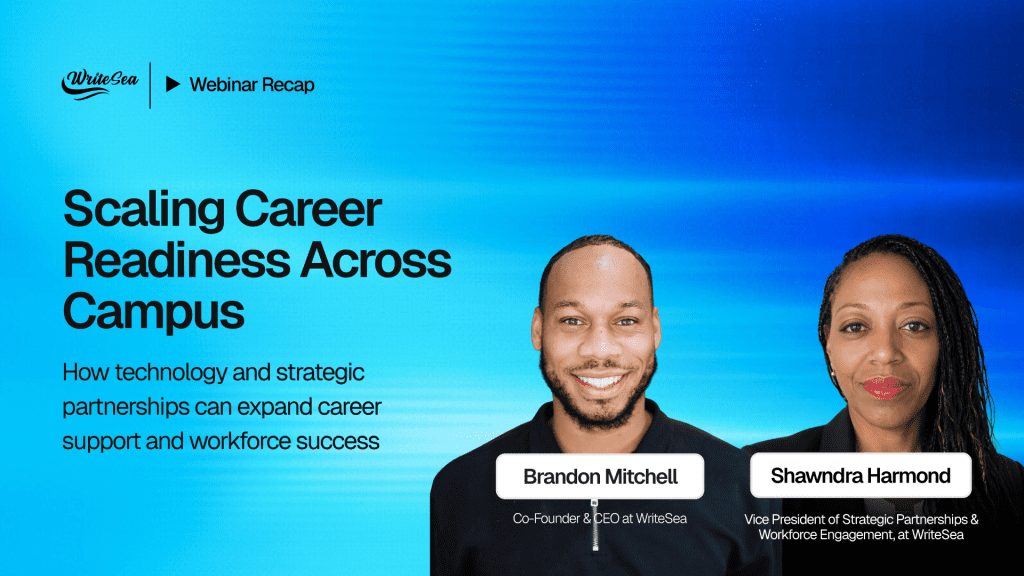
Drawing on Shawndra’s extensive experience in career services, workforce development, higher education and career and technical education, they explored how institutions can build a more connected and scalable approach to career readiness.
Their conversation examined how leadership, faculty, advisors, employers, alumni, technology and data can work together to extend career support beyond the students who actively visit the career center.
As Shawndra explained:
“Everybody must share ownership when it comes to career development, and it has to be embedded throughout the full student experience.”
— Shawndra Harmond, Vice President of Strategic Partnerships and Workforce Engagement, WriteSea
The message throughout the discussion was clear: career readiness is most effective when it becomes part of the institution’s culture rather than the responsibility of one department.
🎥 Missed it live?
Watch the recording .
Meet the Experts
🔹 Shawndra Harmond — Vice President of Strategic Partnerships and Workforce Engagement, WriteSea
Shawndra Harmond brings more than 25 years of experience advancing student success across career services, workforce development, higher education, career and technical education, and secondary education.
Before joining WriteSea, she held university career services leadership roles supporting approximately 9,000 students. Her work has focused on cross-campus collaboration, employer engagement, workforce development and the creation of career-connected ecosystems that help institutions serve students more effectively.
Her experience also includes work with a higher education coordinating board and serving as a high school teacher. This broad perspective has allowed her to see career readiness across the full learner journey, from secondary education through college and into the workforce.
🔹 Brandon Mitchell — Co-Founder and CEO, WriteSea
Brandon Mitchell is a technology entrepreneur, executive coach and investor focused on helping colleges and universities strengthen student outcomes through connected career readiness infrastructure.
Before founding WriteSea, Brandon worked in technology consulting at PwC, where he advised Fortune 500 companies on complex technology challenges. His experience spans technology, SaaS, leadership, career development and organizational strategy.”
As host of the WriteWay Webinar Series, Brandon brings together leaders from education and industry to explore career readiness, innovation and the future of work.
Career Readiness Must Become an Institutional Strategy
For many students, the career center exists in the background until graduation begins to feel close. They may hear about it during orientation, receive occasional emails or encounter it through a class presentation, but meaningful engagement often starts only when they need a job.
That model makes it extremely difficult for a small career services team to reach every student at the moments when support could have the greatest impact.
During the webinar, Shawndra emphasized that institutions need to introduce career development earlier and reinforce it through multiple parts of the student experience.
“Traditionally, students wait until the last minute to show up at the career center. It’s been existing there all along.”
— Shawndra Harmond
Career readiness should not depend on whether a student independently decides to book an appointment. Faculty, advisors, student affairs, academic affairs and institutional leaders all have opportunities to connect students with career resources and help them understand how their education relates to their future.
This means moving career development into spaces students already occupy: classrooms, advising conversations, first-year programs, senior seminars, student organizations, experiential learning and digital platforms.
Brandon reinforced that this work needs to be supported by institutional leadership and connected to the curriculum.
“As we think about more curricular integration, that’s how we can start to embed this into the fabric of an institution.”
— Brandon Mitchell, Co-Founder and CEO, WriteSea
When career readiness becomes an institutional strategy, the question changes from “How can the career center reach more students?” to “How can the entire institution help every student prepare for the workforce?”
Leadership Buy-In Changes Student Engagement
Institutional commitment has a direct effect on whether students know about and participate in career programming.
Shawndra shared an example of a career fair that previously attracted approximately 250 students. Once university leadership actively supported the event, promoted it through the learning management system and asked faculty and staff to reinforce it across campus, attendance increased to approximately 1,600 students.
“Once the university got behind the career center, 1,600 students showed up, where only 250 showed up previously.”
— Shawndra Harmond
The career fair itself had not suddenly become a different event. What changed was the institution’s willingness to communicate its importance consistently and use multiple channels to reach students.
That example illustrates why career services teams cannot be expected to generate campus-wide engagement alone. Students are more likely to act when the same message is reinforced by instructors, advisors, administrators and institutional systems.
Leadership support also signals that career readiness is not an optional extracurricular activity. It is part of the value the institution intends to deliver.
As Brandon noted, this commitment needs to extend beyond broad statements of support:
“If it’s not a mandate, if it’s not a directive, sometimes we feel that it just won’t move the needle.”
— Brandon Mitchell
For colleges and universities, creating that momentum may begin with a president, provost or vice president establishing career readiness as a strategic priority. It is then reinforced through resources, accountability, communication and participation across departments.
What a Scalable Career Readiness Ecosystem Looks Like
Scaling career readiness does not simply mean scheduling more appointments or asking staff to host more events. It means creating an ecosystem in which support remains accessible even when a student cannot visit the career center.
Shawndra summarized the goal directly:
“To me, it means that every student has access to career support. Period.”
— Shawndra Harmond
In a scalable model, students encounter career development through professors, advisors, departments, alumni, employers, experiential learning opportunities and technology.
The career center remains essential, but it becomes the connector and strategic leader of a broader campus effort.
This approach is particularly important for institutions with large, diverse or distributed student populations. Graduate students, online learners, working adults and students with limited time on campus may not engage through traditional appointments and events. They still need access to relevant guidance, tools and opportunities.
“It’s not just for those students who visit the career center. Institutions need to embed within their education employer partnerships, experiential learning opportunities, data and technology, and things that can scale across the entire student population.”
— Shawndra Harmond
A scalable ecosystem therefore brings together human support, clear processes and technology. It allows staff to focus their time where personal expertise and coaching matter most while ensuring that students can access foundational career resources when they need them.
Breaking Down Silos Across Campus
Many universities already have valuable employer relationships, career expertise and student support distributed across campus. The challenge is that those resources are often disconnected.
Shawndra illustrated this through a common scenario: a business school invites an employer such as Deloitte to engage with business students, without realizing that the same organization may also be recruiting students in information technology or computer science.
When colleges and departments operate separately, students miss opportunities and employers may need to navigate multiple disconnected relationships with the same institution.
“If you have a collaborative effort, a collaborative spirit, and you work with multiple departments, then you get university buy-in.”
— Shawndra Harmond
One practical approach Shawndra used was a career task force with representatives from different departments. The group met monthly to exchange information about industry trends, employer needs, new resources and opportunities for students.
Department advisory boards also created a valuable feedback loop. Employers could share what they were seeing in the workforce, what skills they needed and what changes were emerging within their industries. Career services could then bring those insights back to faculty and campus partners.
These conversations sometimes uncovered opportunities that would otherwise have been missed, including grants, donated equipment, professional clothing and employer participation in campus programs.
For institutions without a formal task force or advisory structure, Shawndra recommended beginning with the people who are already helping students find opportunities, even if career development is not part of their formal role. Regional workforce organizations, faculty champions, student leaders and engaged employers can become the foundation of a new collaborative network.
As Brandon observed:
“Even if the infrastructure isn’t there, it can be created.”
— Brandon Mitchell
Embedding Career Readiness into the Curriculum
Faculty engagement emerged as one of the webinar’s most important themes. In an attendee poll, faculty and academic departments were identified as the campus group most in need of greater involvement in career readiness strategy.
That does not mean faculty members must become career counselors. It means helping them identify natural opportunities to connect academic learning with careers.
“Nobody’s requiring a faculty member to become a true career counselor, but through regular, everyday conversation and curriculum, there’s always the opportunity to tie it back to career readiness.”
— Shawndra Harmond
Career readiness is broader than résumé writing. It includes communication, public speaking, professional branding, interviewing, digital presence, workplace expectations and the ability to explain how academic knowledge applies in a professional setting.
Shawndra described offering short faculty development sessions focused on new career tools, trends and techniques instructors could implement immediately. Increasing awareness helped faculty connect students with resources such as mock interviews, professional headshots and job application tracking.
Brandon offered an example of how this could work within a marketing course. A student might identify an actual marketing position, complete a simulated interview and connect the employer’s requirements to the concepts being taught in class.
“They can start to tie what they’re teaching, which is the theory, to an actual job. Students can see how what they’re learning connects to the workforce.”
— Brandon Mitchell
Waiting until a final-year seminar to introduce these skills is often too late. Students benefit when career exploration and preparation begin early enough for them to pursue internships, build relevant experience, develop professional relationships and adjust their plans.
“It’s a little late to just be talking about a résumé. We needed this in the beginning.”
— Brandon Mitchell
Using Technology to Expand Access and Improve Support
Technology can help institutions make career support available beyond office hours and individual appointments. It can also help smaller teams serve more students without removing the human guidance that makes career services valuable.
Students are already using general-purpose AI tools for résumés, applications and interview preparation. However, without appropriate guidance or vetted resources, they may submit inaccurate, generic or even fabricated information.
Shawndra recalled seeing résumés containing content left behind from ChatGPT or descriptions of companies and experiences that did not exist.
The answer is not necessarily to tell students to avoid AI. Institutions can teach them how to use it responsibly and provide tools that work from their genuine experiences.
“Students are already using it, and so I feel like the university should embrace it and make sure that they understand the capabilities of what the software and different platforms can do.”
— Shawndra Harmond
Technology selection, however, needs to be intentional. Shawndra described reviewing an institution’s existing platforms and discovering overlapping contracts, expensive features with limited participation, tools restricted to individual schools and functionality that was not being used.
Her team created a checklist, compared the capabilities and costs of each platform, renegotiated existing contracts and removed redundant systems.
Brandon encouraged institutions to consider the needs of their specific student populations, speak directly with students and evaluate multiple vendors before implementation.
“Talk to the students. Ask them: What are you interested in? What do you need? What are your gaps?”
— Brandon Mitchell
Pilots can also help career services teams and students evaluate whether a platform aligns with institutional standards and existing resources before a broader rollout.
The goal is not to accumulate more tools. It is to build a connected technology strategy that improves access, reduces duplication, supports staff and helps students take meaningful action.
Measuring What Matters
Institutions cannot strengthen career readiness without understanding what is working, where students are disengaging and what outcomes their efforts are producing.
During the opening polls, approximately 93% of webinar respondents reported being either only somewhat confident or not confident in their institution’s ability to track career readiness effectively. Many also indicated that they were using multiple tools but dealing with fragmented data.
Shawndra encouraged institutions to look beyond basic activity measures and track a broader set of indicators.
“They should track employment outcomes, career competencies, experiential learning, measures for student engagement, institutional ROI, attendance and employer satisfaction.”
— Shawndra Harmond
Attendance data becomes more useful when institutions investigate the reasons behind it. If an employer arrives intending to hire 25 students and only two attend, the question is not simply how many students showed up. Leaders need to understand whether the opportunity was communicated clearly, whether students understood the organization and whether faculty and departments helped reach the right audiences.
Employer branding can also shape student participation. Students may dismiss an organization based on its industry or name without realizing it is recruiting accountants, technology professionals, attorneys, marketers or engineers.
“As Brandon summarized:
“Employer branding, asking more questions, understanding the why and looking at your stack—these are all really good strategies.”
— Brandon Mitchell
Connecting engagement, experiential learning, employer satisfaction and employment outcomes gives leaders a stronger view of the institution’s career readiness ecosystem. It also helps career services teams build a clearer case for funding, technology and additional support.
Preparing Students for a More Uncertain Job Market
The current job market requires institutions to have honest conversations with students. A degree remains valuable, but graduation does not automatically produce immediate employment, and some industries are changing more quickly than students may realize.
Shawndra described using alumni engagement to make those realities more tangible. Alumni could speak candidly about how long their job searches took, how internships influenced their outcomes and what they wished they had done earlier.
“Today’s climate has changed. These are things that you have to have honest conversations with your students about.”
— Shawndra Harmond
Brandon emphasized that students may need to conduct broader, more persistent and more visible job searches. That can include applying to more opportunities, tracking applications, following up, building professional networks and sharing their perspectives on platforms such as LinkedIn.
“It’s harder than ever, and so you have to be more serious and you have to be more diligent.”
— Brandon Mitchell
Students may also need help expanding how they think about potential employers and career paths. An accounting graduate does not have to work only in a traditional accounting environment, just as a technology student may find opportunities in industries they had never previously considered.
Career mapping can help students understand how their competencies transfer across roles and sectors. This allows institutions to prepare students for uncertainty without discouraging them, offering a wider view of the opportunities their education can support.
Your Action Plan: 5 Ways to Get Started
Scaling career readiness is a long-term institutional effort, but colleges and universities do not need to transform everything at once. The webinar offered several practical places to begin.
1. Establish Career Readiness as a Shared Institutional Priority
Secure visible support from senior leadership and define career readiness as part of the institution’s responsibility to students.
Communicate that priority through faculty, advisors, student affairs, academic departments and campus systems so that students encounter a consistent message throughout their education.
As Shawndra explained:
“Scaling requires leadership commitment, technology, shared accountability, and making career readiness part of the student journey from day one.”
— Shawndra Harmond
2. Create a Cross-Campus Career Readiness Group
Bring together representatives from career services, academic departments, faculty, alumni relations, student affairs, employer engagement and workforce organizations.
Use regular meetings to share employer insights, identify overlapping relationships, coordinate student communication and uncover opportunities that may otherwise remain within departmental silos.
3. Integrate Career Learning into Existing Courses and Experiences
Begin with courses and programs where career connections already exist. Give faculty practical tools and examples they can use without redesigning their entire curriculum.
Assignments involving real job descriptions, mock interviews, professional communication, portfolios and career mapping can help students connect classroom learning with workplace expectations.
4. Audit Your Technology and Use Student Feedback
List the platforms currently being used across the institution, the features available, the populations served and the costs involved.
Identify duplication and underused functionality. Ask students what they need, include them in evaluations and pilot potential solutions before committing to a broader rollout.
Technology should make career support more accessible and coordinated, not add another disconnected system.
5. Track Outcomes and Investigate the Story Behind the Data
Measure more than appointments and event registrations. Examine employment outcomes, competencies, experiential learning participation, engagement, employer satisfaction and institutional return on investment.
When participation is low, ask why. When an employer continues returning, identify what is working. Use those insights to improve communication, strengthen partnerships and demonstrate the value of career readiness to leadership.
Closing Thought
Career services teams remain central to student success, but they cannot and should not carry career readiness alone.
Students need repeated opportunities to explore careers, develop skills, build experience, engage with employers and understand how their education connects to the workforce. Delivering that support at scale requires leadership commitment, collaboration across departments, engaged faculty, relevant technology and better use of data.
As Brandon said during the conversation:
“Let’s establish a culture of career readiness and make it a priority, because the world is changing.”
— Brandon Mitchell
The institutions best positioned to support students will be those that stop treating career readiness as a service students must find and start building it into the educational journey from the beginning.
When the entire campus shares responsibility, career development becomes more visible, more accessible and more connected to the outcomes students are working toward.
Book a Personalized Demo
See how WriteSea helps institutions:
- Scale career support across the student population
- Improve student engagement and career readiness
- Deliver AI-powered résumé, cover letter and mock interview support
- Connect career development with experiential learning and employment outcomes
- Strengthen follow-up and first-destination data collection
Want to Go Deeper?
📩 Subscribe to The Write Way Newsletter
Stay ahead with weekly insights on AI, career readiness, student success and higher education innovation.
👉🏽 Subscribe here.
🎓 Explore WriteSea for Higher Education
Learn how WriteSea helps institutions scale support, strengthen career readiness and better measure outcomes across the student lifecycle.
👉🏽 Learn more.
🔗 Connect with Shawndra Harmond on LinkedIn
Follow Shawndra’s work in career services, employer engagement, workforce development and campus-wide career readiness.
👉🏽 Connect with Shawndra.
🔗 Connect with Brandon Mitchell on LinkedIn
Learn more about career readiness, AI-powered student success and workforce development in higher education.
👉🏽 Connect with Brandon.
▶️ Watch Our Previous Webinar
Watch Brandon Mitchell, Co-Founder and CEO of WriteSea, Dr. Aaron Duvall, Executive Director of Workforce Development at the University of Arkansas at Little Rock, and Brittany Straw, Director of Career Services at the University of Arkansas at Little Rock, explore how integrating workforce development and career services can strengthen employer partnerships, improve campus collaboration and create more connected pathways from education to employment.
👉🏽 Watch How Integrating Workforce Development and Career Services Strengthens Student Success.
Join The Write Way Newsletter
Gain access to a wealth of industry insights, news updates, and exclusive executive interviews from top leaders in the higher education and online recruitment marketplace industry.