
Beyond Resume Builders: How AI Is Changing the Entire Student Career Journey
Share this article
In this article


Introducing The Write Way: Your Weekly Career Innovation Digest
Join 1,000+ career services professionals who receive industry news, the latest trends, and insights on AI every single week straight to their inbox.
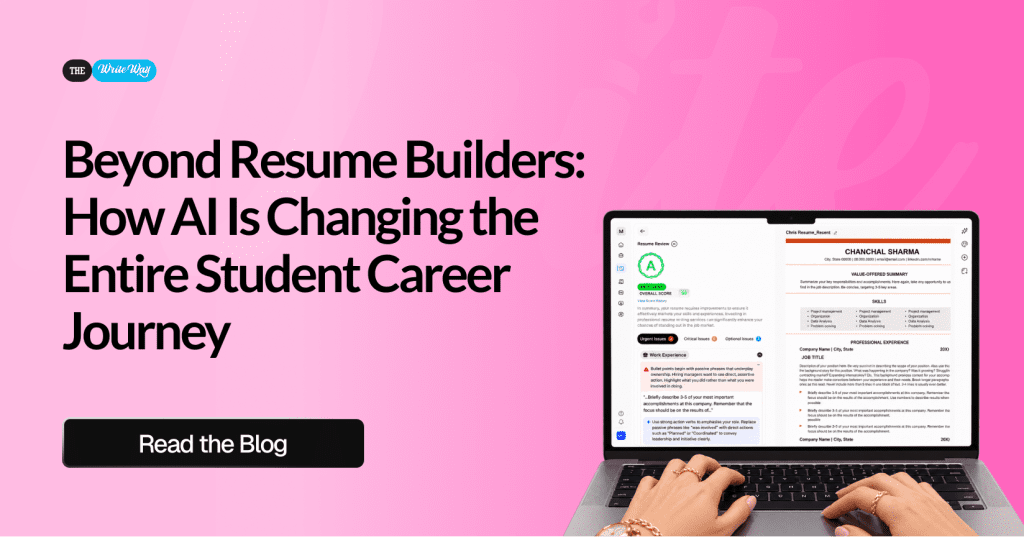
AI in career services is often discussed in terms of one task: helping students write a resume. That is understandable. Resume feedback is a practical starting point for using AI, and students can see the results immediately.
But preparing for work involves much more than producing a polished document.
Students need to explore career options, understand their strengths, connect their academic experience to workplace skills, prepare for interviews, evaluate job opportunities and make decisions about their professional development. Those needs continue after graduation, too.
For colleges and universities, the question is no longer simply whether AI can help a student improve a resume. It is where the technology can provide useful support throughout the career journey—and where students still need the judgment, encouragement and expertise of a person.
The National Association of Colleges and Employers (NACE) defines career readiness around competencies that prepare college graduates for workplace success and lifelong career management. Its framework includes career and self-development, communication, critical thinking, professionalism, teamwork and technology, among other competencies.
That broader definition offers a useful way to think about AI in career services. Rather than treating it as a standalone writing tool, institutions can consider how AI might help students practise skills, explore possibilities and prepare for career decisions at different stages of their education.
1. AI can help students explore career options
Students do not always arrive at college with a clear idea of what they want to do after graduation.
Others have a broad career goal but are unsure how their degree, interests and experience connect to specific roles.
AI tools can help students begin exploring those questions. A student might use a tool to compare occupations, identify common skills across job descriptions, investigate industries or generate questions to discuss with a career adviser.
For example, a student studying communications might explore roles in public relations, internal communications, digital marketing and corporate communications. Comparing job descriptions can help the student see where the roles overlap and which skills or experiences differ.
This kind of exploration can give students a starting point for further research. It can also help them arrive at a career advising appointment with more specific questions.
However, AI-generated career suggestions should not be treated as definitive recommendations.
Responses may overlook local opportunities, industry requirements, the student’s circumstances or career paths that do not fit conventional patterns. Students should verify information and consider advice from career professionals, faculty, alumni and people working in the fields that interest them.
For career services teams, the opportunity is to use AI-supported exploration as a starting point for more focused conversations—not as a substitute for helping students make informed decisions.
2. Resume and interview preparation can become more practical
Resume builders and interview preparation tools remain useful applications of AI because they help students work on tasks that can otherwise feel unfamiliar or intimidating.
A student can use AI to compare a resume with a job description, identify experience that may be relevant to a role, improve the clarity of bullet points or practise answering interview questions.
Students can also ask for feedback on whether their examples clearly explain the situation, their actions and the result.
The value is not simply producing a better first draft. It is helping students understand why one version communicates their experience more effectively than another.
For instance, a student applying for an internship may have experience from a class project, campus organization, part-time job or volunteer role. They may not immediately recognize how that experience demonstrates communication, teamwork, problem-solving or leadership.
Guided practice can help them identify relevant examples and explain them clearly.
AI feedback still needs to be checked. A tool may suggest language that exaggerates a student’s responsibilities, introduce details that were never provided or make a resume sound generic.
Students should be encouraged to verify every claim and retain ownership of the final application.
Interview preparation also needs to go beyond memorizing answers. Students should practise explaining their reasoning, responding to follow-up questions and adapting their examples to different situations.
Used well, AI can make practice easier to access between appointments. Career professionals can then spend more time on the feedback, context and coaching that a tool cannot reliably provide on its own.
3. AI can support the job search, not just the application
Finding a job involves more than sending out resumes. Students need to identify suitable opportunities, understand job requirements, organize applications, prepare for employer conversations and decide where to focus their time.
AI can help with parts of this process. Students might use it to identify recurring requirements across job advertisements, organize a list of opportunities, prepare questions for a recruiter or plan how to follow up after an interview.
It can also help students understand unfamiliar language in job descriptions. If an advertisement asks for stakeholder engagement, data analysis or project coordination, a student can explore what those terms mean in that role and consider whether their existing experience provides relevant examples.
The important distinction is between supporting a job search and automating decisions without sufficient review.
Students should not assume that an AI-generated job recommendation is accurate, that a role is still open or that they meet every requirement simply because a tool says so. Job details should be checked against the employer’s original listing. Students also need to protect their personal information when using external platforms.
Institutions can help by teaching students how to use AI to organize and evaluate opportunities while maintaining control over their applications and decisions.
This is particularly relevant for students who are navigating recruitment for the first time. A tool can help them practise a process, but they still need to understand how to assess an opportunity, communicate with employers and make decisions that fit their goals.
4. AI can extend career coaching between appointments
Career advisers bring context, experience and human judgment to conversations about work. But campus career services teams may have limited capacity to provide individual support to every student at every stage.
AI tools may help students prepare for appointments, work through common questions, reflect on their experiences or identify areas they want to discuss with an adviser. They can also provide opportunities for additional practice after a meeting.
A student who receives feedback on an interview answer, for example, could use an AI tool to practise a revised response before the next appointment. Another student might use a guided exercise to identify skills developed through coursework, employment or extracurricular activities.
These uses can make the time between appointments more productive. They may also help students arrive with clearer questions and a better understanding of where they need support.
But career decisions are rarely just technical problems. A student weighing two job offers may be considering financial responsibilities, location, family expectations, accessibility, workplace culture or long-term goals. A tool may help organize the factors, but it cannot fully understand the student’s circumstances or take responsibility for the decision.
Institutions should also be clear about what information students can safely share with AI systems and whether their conversations are stored or used by a provider. NACE’s guidance on applying its ethical professional practice principles to AI emphasizes considerations such as transparency, fairness and security in career services and recruitment.
The aim should be to extend access to useful support without presenting automated responses as a replacement for professional advising.
5. Career support can continue beyond graduation
The student career journey does not end when someone receives a first job offer. Graduates continue to develop skills, change roles, pursue further education and respond to changes in their industries.
AI may help with ongoing career development by supporting skills reflection, identifying learning goals, preparing for performance conversations or comparing the requirements of new roles with a person’s existing experience.
For example, an alumnus considering a move into management might use an AI tool to identify common responsibilities in relevant job descriptions and compare them with their current experience. That comparison could inform a professional development plan or a conversation with a mentor.
For institutions, this creates a reason to consider career support as a longer-term relationship rather than a service students use only during their final year. Alumni career services, continuing education and employer engagement can all contribute to that relationship.
The technology should still be used with care. Career paths are not always linear, and automated recommendations may reproduce narrow assumptions about qualifications or progression.
Graduates need to evaluate suggestions against their own goals and seek reliable advice when making consequential decisions.
The wider point is that AI can support repeated cycles of reflection, practice and development. That is a more expansive role than helping someone prepare a single application.
What universities should consider before expanding AI in career services
AI tools are becoming easier to access, but adopting a tool and improving student outcomes are two different things. Institutions should start with the career development need they want to address and determine whether AI is an appropriate way to support it.
Start with the student need
Identify where students experience difficulty or where existing services have limited capacity. The right use case may be interview practice, career exploration or help understanding job descriptions. It does not have to be the newest or most visible AI application.
Keep human expertise in the process
Decide which activities can be supported by AI and which require a career professional. Students should have clear ways to access human guidance, especially when decisions involve complex circumstances or significant consequences.
Teach students to use AI responsibly
Students need more than access to a tool. They need guidance on checking claims, protecting personal information, recognizing limitations and ensuring that applications represent their actual experience. Institutions should explain when AI use is appropriate and what employers may expect from applicants.
Consider access and inclusion
Not all students have the same access to technology, confidence using AI or familiarity with its limitations. Institutions should consider accessibility, language needs, the cost of tools and whether the service works for students with different backgrounds and circumstances.
Evaluate what changes
Usage numbers alone do not show whether a tool is helping students. Institutions can examine whether students complete more practice activities, improve the quality of their applications, report greater confidence or make better-informed career decisions. Evaluation should match the purpose of the intervention, and institutions should avoid attributing employment outcomes to a single tool without adequate evidence.
NACE’s career readiness framework provides one possible reference point for connecting career development activities to competencies such as career and self-development, communication, critical thinking and technology. Institutions should select the measures that fit their own goals rather than assuming that one framework or metric captures every aspect of career readiness.
Final thought
AI in career services is often introduced through resume writing because the task is familiar and the results are easy to see. But students need support before, during and after the application process.
AI can help students explore career possibilities, practise interviews, make sense of job requirements and plan their professional development. It can also give them more opportunities to practise between conversations with career advisers.
The opportunity for higher education is to connect these uses to a broader approach to career readiness. That means choosing tools based on student needs, teaching responsible use, preserving access to human guidance and evaluating whether the support is making a meaningful difference.
A resume is one step in a student’s career journey. It should not be the limit of the conversation about AI.
Explore how WriteSea supports career readiness at your institution. Visit WriteSea to learn more about its approach to career preparation and student support
Book Your Free Demo
See how WriteSea helps your team measure career outcomes, identify risk early, and improve engagement without the manual lift.
Subscribe to The Write Way
Get weekly strategies, insights, and pro tips on career readiness, outcomes measurement, and scalable systems for higher ed teams.

Brandon Mitchell
Brandon Mitchell is the Founder and CEO of WriteSea, an AI-powered career services platform that helps educational institutions and workforce development offices improve the job seeker experience. He has over eight years of experience helping job seekers and organizations leverage technology for career mobility, and previously worked as a technology consultant at PwC. Brandon has been featured in Yahoo Finance, Forbes, and other outlets for his work in career development, technology, and entrepreneurship. Brandon is based in Tulsa, and enjoys hosting on Airbnb, traveling, and pickleball.
References
- National Association of Colleges and Employers (NACE). “What Is Career Readiness?” https://www.naceweb.org/career-readiness/competencies/career-readiness-defined
- National Association of Colleges and Employers (NACE). “Guidance on Applying NACE’s Principles for Ethical Professional Practice to AI.” September 8, 2025. https://www.naceweb.org/talent-acquisition/best-practices/guidance-on-applying-naces-principles-for-ethical-professional-practice-to-ai