
WriteSea

Why Career Readiness Should Be Part of Every College Degree

Share this article

In this article

image 1
image

Introducing The Write Way: Your Weekly Career Innovation Digest

Join 1,000+ career services professionals who receive industry news, the latest trends, and insights on AI every single week straight to their inbox.
New Banner 98
A student can complete a degree, pass their courses and graduate with strong subject knowledge without knowing how to explain their skills to an employer, navigate a professional environment or connect their academic experience to a career.
 
That gap matters to higher education institutions. Students need a strong academic foundation, but they also need opportunities to recognize what they can do with what they’ve learned.
 
The National Association of Colleges and Employers (NACE) defines career readiness as the development of competencies that prepare college-educated individuals for workplace success and lifelong career management. Its framework connects career preparation to activities across curricular and extracurricular experiences, rather than limiting it to a single service or department.
 
There is also a practical institutional challenge. In a NACE article reporting on a faculty survey conducted with the American Association of Colleges and Universities (AAC&U) and the Society for Experiential Education, more than one-third of faculty respondents said they had not integrated career readiness into their courses because they lacked the background or expertise.
 
That finding points to an opportunity for colleges: make career readiness a shared responsibility, give faculty practical support, and help students connect what they learn in class with the skills they will need beyond campus.

1. Why career readiness needs to move beyond the career center

Career centers play an essential role in helping students explore career options, prepare applications, practise interviews and connect with employers. But students develop career-relevant skills throughout their college experience, often in places that have little to do with a formal career appointment.
 
A student may learn to analyze evidence in a biology course, manage competing deadlines in a history seminar, communicate complex information in a communications class or collaborate on a software project. These experiences can help develop skills that matter in the workplace. The challenge is ensuring students recognize those skills and can explain how they apply beyond the classroom.
 
If career preparation is concentrated mainly in the final year, students may have limited time to explore different paths, gain relevant experience and address skill gaps before graduation.
 
A campus-wide approach creates more opportunities to build career readiness over time. Career services can help students interpret their experiences and connect them with professional opportunities. Faculty can make career relevance visible within their disciplines. Academic leaders can support consistency across programs, while employers and alumni can contribute perspectives on how knowledge is used in practice.
 
The aim is not to turn every instructor into a career adviser or make every class a job-preparation course. It is to ensure that students have opportunities to understand the relevance of their learning and develop skills that transfer to professional and civic life.
 

What this means for university leaders

Start by asking where career development already happens across the institution. Look at academic projects, internships, clinical placements, laboratory work, student organizations, capstone courses and community partnerships.
 
The next question is whether students are being helped to recognize and communicate what they gain from those experiences.
 
A career center can provide the shared resources, expertise and coordination to help make that connection without taking ownership away from academic departments.

2. Connecting academic learning and employability

pexels kampus 5940829
Students should not have to choose between an academically rigorous education and preparation for employment. The two can reinforce one another when programs make the relationship between disciplinary knowledge, practical application and career-relevant skills explicit.
 
Research published through NACE has examined how course-based career experiences can strengthen the connection between higher education and work. Examples include employer-related assignments, applied projects, case studies, simulations, career exploration activities and opportunities for students to receive feedback on their professional development. 
 
The key is to connect these activities to meaningful learning outcomes rather than adding workplace themes simply for the sake of appearing career-focused.
 
Consider how this might work across different disciplines:

  • Biology: Students analyze a dataset, explain their findings to a non-specialist audience and discuss how the work relates to research or health-related careers.
  • Business: Students develop a recommendation for a real or simulated organizational problem, defend their decisions and respond to feedback.
  • English or communications: Students adapt a piece of writing for different audiences and explain how their choices affect clarity, persuasion and interpretation.
  • Computer science: Students collaborate on a project, document their decisions, test their work and present the solution to an audience.
  • History or social sciences: Students assess conflicting sources, construct an evidence-based argument and communicate their conclusions clearly.

These are not replacements for disciplinary learning. They are ways to help students practise applying that learning while developing the ability to explain their decisions, evaluate evidence and work with others.
 
Students also need help translating experience into language employers understand.

Completing a research project, for example, may develop analytical thinking, project management and communication. But a student who has never reflected on those connections may struggle to describe them in an interview.
 
Career readiness becomes more tangible when students can identify what they did, what skills they used, what they learned and how they could apply that experience in another setting.

3. Embedding career skills into degree programs

Integrating career readiness does not require every department to create a new course or redesign its entire curriculum. Institutions can begin by identifying existing learning activities that develop career-relevant competencies and making those connections more intentional.
 
A useful starting point is to establish a shared understanding of the skills students should develop.
 
NACE’s career readiness framework provides a reference for competencies including communication, critical thinking, leadership, professionalism, teamwork, technology, and career and self-development.
 
Departments can then consider how students practise and demonstrate these competencies at different stages of a degree.
 

Map skills across the student experience

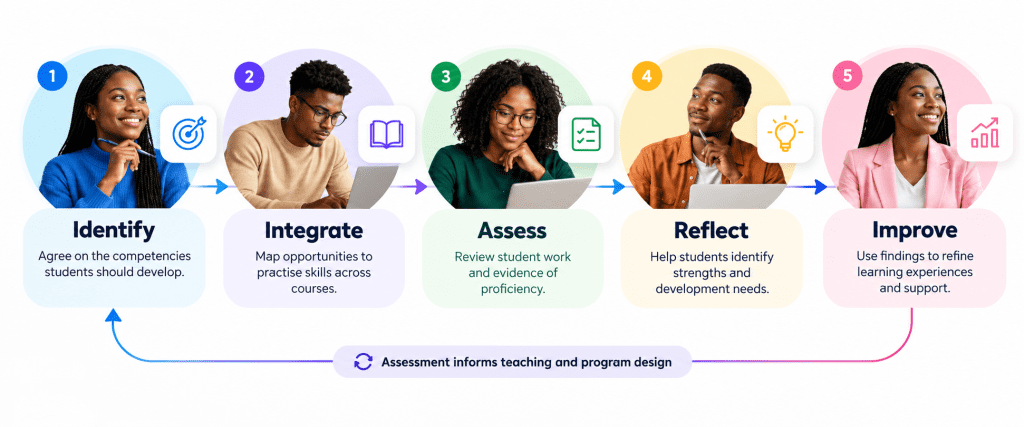
A curriculum map can help academic leaders identify where students first encounter a skill, where they practise it and where they demonstrate greater proficiency.
 
For example, a degree program might introduce collaborative work in the first year, develop it through group assignments in the second and third years, and assess it through a final-year project involving multiple contributors.
 
The goal is progression. Students should have opportunities to practise, receive feedback, reflect and improve rather than encounter a competency once and be expected to master it immediately.
 

Give faculty practical support

Faculty members know their disciplines, but they may not have the time or resources to develop career readiness activities independently. The NACE faculty research highlights this as a real barrier and points to opportunities for career centers to provide faculty toolkits, career information and examples that connect course outcomes with career competencies. 
 
Useful resources could include:
 
  • Examples of assignments that develop transferable skills.
  • Reflection questions students can use after projects or experiential learning.
  • Rubrics for assessing communication, teamwork or problem-solving.
  • Current information about career pathways and relevant workplace applications.
  • Activities that help students describe their skills in resumes, interviews and professional portfolios.
 
This support should be adaptable to different disciplines. A communication competency will look different in a nursing program than in a computer science program, even when the underlying ability to communicate clearly is shared.
 

Make reflection part of the learning process

Completing an assignment is not the same as understanding what it demonstrates. Students benefit from being asked to explain the decisions they made, the skills they used, the feedback they received and what they would do differently next time.
 
A short reflection after a laboratory project, internship or team assignment can help students recognize their development and build examples they can use when discussing their experience with employers.
 
When these practices are built into existing coursework, career development becomes part of the learning experience rather than an additional responsibility students must discover on their own.

4. Measuring career readiness across programs
Measuring Career Readiness Across Degrees
If career readiness is a campus-wide priority, institutions need a way to understand whether students are developing the intended skills and where additional support may be needed.
 
Counting career fair attendance, advising appointments or completed workshops can help career services teams understand engagement. Those measures do not, by themselves, show whether students have developed particular competencies or can demonstrate them in practice.
 
A stronger approach connects assessment to the learning activities where students are expected to develop those skills.
 
NACE’s Competency Assessment Tool provides rubrics for its career readiness competencies, including student and observer assessments. Its suggested process involves reviewing proficiency, discussing the results and setting development goals. 
 
Institutions can use such resources as a reference when designing an assessment approach appropriate to their own programs and requirements.
 

Assess skills through real work

Different disciplines can use different assignments while assessing comparable underlying competencies.
 
For example, a presentation in a business course and a research presentation in a science course may both provide evidence of communication. A team design project and a collaborative clinical assignment may both provide evidence of teamwork, although the professional context and assessment criteria will differ.
 
Institutions can agree on common definitions and broad assessment principles while allowing academic departments to determine what proficiency looks like in their fields.
 

Combine evidence rather than relying on one score

A useful assessment plan may draw on several sources:

  • Student reflections on skills developed through coursework and experiential learning.
  • Faculty assessments of student work using clear criteria.
  • Portfolios containing projects, presentations and other examples of demonstrated ability.
  • Student surveys about confidence and opportunities to practise career-relevant skills.
  • Internship or employer feedback, where appropriate and collected responsibly.
  • Participation and completion data for relevant learning experiences.

Each measure answers a different question. Self-reported confidence, for instance, is not the same as demonstrated proficiency. Internship participation does not automatically establish that a student has developed every intended competency.
 
Institutions should interpret these measures together and avoid claiming that a single intervention caused a particular employment outcome without evidence that supports that conclusion.
 

Connect learning measures with graduate outcomes

Employment and earnings data can provide additional context. In October 2025, Georgetown University’s Center on Education and the Workforce published The Major Payoff, examining earnings and employment outcomes across bachelor’s degree majors. The report documents substantial variation in outcomes across fields of study. 
 
The U.S. Department of Education also updated College Scorecard earnings information in March 2026, including earnings outcomes four years after graduation for additional completion cohorts.
 
The Department cautions that institution-level earnings figures do not predict an individual graduate’s likely earnings and may not reflect differences between programs at the same institution.
 
These sources illustrate why institutions need more than one measure of success. Graduate outcomes matter, but they are influenced by many factors beyond a student’s career readiness or a university’s career services.
 
Universities should combine outcome data with evidence about what students learn, the opportunities they receive and the competencies they can demonstrate. That gives academic and career services leaders a more useful basis for identifying strengths, gaps and areas for improvement.

5. Building a campus-wide strategy

A campus-wide approach needs clear ownership, practical support and a manageable starting point. Without coordination, individual departments may develop useful activities that remain disconnected from the wider institutional strategy.
 
University leaders can help by setting shared priorities and giving academic departments and career services the resources to work together.
 

Establish shared responsibility

Define the roles of academic leadership, faculty, career services, experiential learning teams, institutional research and employer engagement staff. Responsibility can be distributed, but the expectations should be clear.
 
Career services can coordinate resources and provide expertise. Faculty can connect competencies to disciplinary learning. Academic leaders can support curriculum planning. Institutional research teams can help design measures and interpret results.
 

Start with a manageable pilot

Rather than launching a campus-wide initiative immediately, choose a small number of programs with different learning models. Work with faculty to identify existing assignments, map relevant competencies and test a practical assessment approach.
 
Use the pilot to understand what works, how much support faculty need and which resources could be adapted for other departments.
 

Build relationships with employers and alumni

Employers and alumni can help academic teams understand how knowledge is applied in different professional contexts. Guest speakers, project feedback, work-based learning and mentoring can provide students with opportunities to engage with professional practice.
 
These relationships should inform academic learning, not determine the entire curriculum. Universities still need to uphold disciplinary standards and prepare students for a range of possible futures.
 

Review the strategy regularly

Career readiness should be reviewed as part of ongoing program improvement.
 
Institutions can examine student feedback, assessment findings, faculty experiences and graduate outcomes to identify where adjustments are needed.
 
A useful strategy does not have to be complicated. It needs shared goals, clear responsibilities, meaningful evidence and a willingness to improve.

What universities can do next

For institutions beginning this work, the first step is to understand what is already happening.
 
Academic programs may already include projects, presentations, internships, research, community engagement and other experiences that develop career-relevant skills. The opportunity is to connect those experiences more deliberately, help students recognize what they are learning and identify gaps that require additional support.
 
A practical starting plan could include:
 
  1. Audit existing opportunities. Identify where students practise career-relevant skills across selected degree programs.
  2. Choose shared competencies. Agree on a manageable set of skills to focus on first.
  3. Partner with faculty. Develop examples, rubrics and reflection activities that fit existing coursework.
  4. Define measures. Decide what evidence will demonstrate student learning and how the findings will be used.
  5. Review and refine. Use the results to improve activities before expanding the approach.
 
This creates a foundation for wider adoption without expecting every department to change everything at once.

Final thought

Career readiness is too important to leave until a student begins applying for jobs. By that point, students should already have opportunities to explore career options, practise relevant skills and understand how their academic experiences translate beyond the classroom.
 
Making career readiness part of every degree does not mean reducing higher education to workforce preparation. It means helping students connect the knowledge they gain with the ability to apply it, communicate its value and continue developing throughout their careers.
 
For university leaders, academic deans, faculty and career services teams, the opportunity is to work together toward that outcome. With shared competencies, practical faculty support and meaningful assessment, career readiness can become a visible part of the student experience across disciplines.
 
Explore how WriteSea supports career readiness in higher education. Visit WriteSea to learn more.

Book Your Free Demo

See how WriteSea helps your team measure career outcomes, identify risk early, and improve engagement without the manual lift.

Subscribe to The Write Way

Get weekly strategies, insights, and pro tips on career readiness, outcomes measurement, and scalable systems for higher ed teams.

Untitled design (5)

Brandon Mitchell

Brandon Mitchell is the Founder and CEO of WriteSea, an AI-powered career services platform that helps educational institutions and workforce development offices improve the job seeker experience. He has over eight years of experience helping job seekers and organizations leverage technology for career mobility, and previously worked as a technology consultant at PwC. Brandon has been featured in Yahoo Finance, Forbes, and other outlets for his work in career development, technology, and entrepreneurship. Brandon is based in Tulsa, and enjoys hosting on Airbnb, traveling, and pickleball.

References

  1. National Association of Colleges and Employers (NACE). “What Is Career Readiness?” https://www.naceweb.org/career-readiness/competencies/career-readiness-defined
  2. Collins, Mimi. “Collaborating With Faculty for Successful Student Outcomes, Institutional Effectiveness.” National Association of Colleges and Employers, April 22, 2024. https://www.naceweb.org/career-readiness/best-practices/collaborating-with-faculty-for-successful-student-outcomes-institutional-effectiveness
  3. Kinzie, Jillian, and Filiz Akyuz. “Exploring the Influence of Course-Based Career Experiences and Faculty on Students’ Career Preparation.” National Association of Colleges and Employers, May 15, 2022. https://www.naceweb.org/research/reports/the-integration-of-career-readiness-into-experiential-learning-and-high-impact-practices/f40e51e5-43e3-4daf-8ff6-376a65ae273c
  4. National Association of Colleges and Employers (NACE). “The NACE Competency Assessment Tool.” https://www.naceweb.org/career-readiness/competencies/the-nace-competency-assessment-tool/
  5. Morris, Catherine, Ban Cheah, and Jeff Strohl. The Major Payoff: Evaluating Earnings and Employment Outcomes Across Bachelor’s Degrees. Georgetown University Center on Education and the Workforce, October 15, 2025. https://cew.georgetown.edu/cew-reports/major-payoff/
  6. Federal Student Aid, U.S. Department of Education. “New Lower Earnings Indicator on the FAFSA® Form.” Updated March 23, 2026. https://fsapartners.ed.gov/knowledge-center/library/electronic-announcements/2025-12-03/new-lower-earnings-indicator-fafsar-form

Ensure Every Student is
Career Ready

If you would like to be featured in WriteSea’s Executive Interview Series, please fill out this form.

Join The WritersBloc

Your Information