
Why Career Readiness Should Be Part of Every College Degree
Share this article
In this article


Introducing The Write Way: Your Weekly Career Innovation Digest
Join 1,000+ career services professionals who receive industry news, the latest trends, and insights on AI every single week straight to their inbox.
1. Why career readiness needs to move beyond the career center
What this means for university leaders
2. Connecting academic learning and employability

- Biology: Students analyze a dataset, explain their findings to a non-specialist audience and discuss how the work relates to research or health-related careers.
- Business: Students develop a recommendation for a real or simulated organizational problem, defend their decisions and respond to feedback.
- English or communications: Students adapt a piece of writing for different audiences and explain how their choices affect clarity, persuasion and interpretation.
- Computer science: Students collaborate on a project, document their decisions, test their work and present the solution to an audience.
- History or social sciences: Students assess conflicting sources, construct an evidence-based argument and communicate their conclusions clearly.
These are not replacements for disciplinary learning. They are ways to help students practise applying that learning while developing the ability to explain their decisions, evaluate evidence and work with others.
Completing a research project, for example, may develop analytical thinking, project management and communication. But a student who has never reflected on those connections may struggle to describe them in an interview.
3. Embedding career skills into degree programs
Map skills across the student experience
Give faculty practical support
- Examples of assignments that develop transferable skills.
- Reflection questions students can use after projects or experiential learning.
- Rubrics for assessing communication, teamwork or problem-solving.
- Current information about career pathways and relevant workplace applications.
- Activities that help students describe their skills in resumes, interviews and professional portfolios.
Make reflection part of the learning process
4. Measuring career readiness across programs
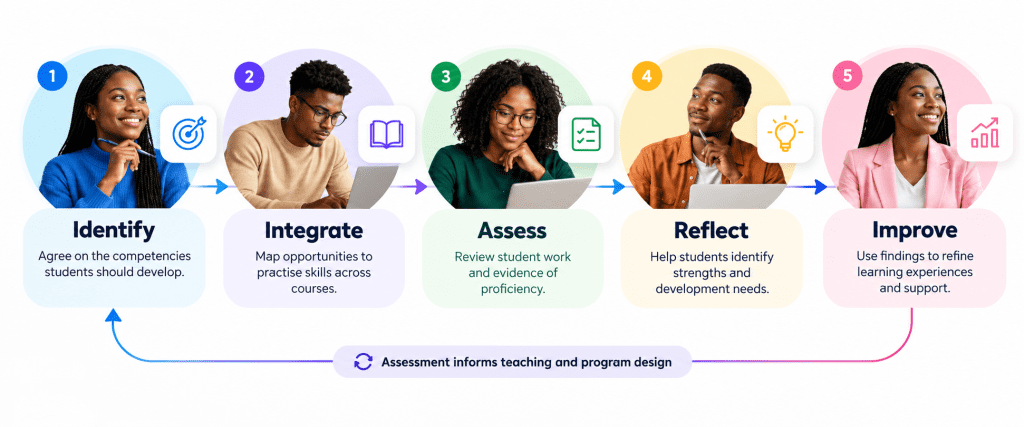
Assess skills through real work
Combine evidence rather than relying on one score
- Student reflections on skills developed through coursework and experiential learning.
- Faculty assessments of student work using clear criteria.
- Portfolios containing projects, presentations and other examples of demonstrated ability.
- Student surveys about confidence and opportunities to practise career-relevant skills.
- Internship or employer feedback, where appropriate and collected responsibly.
- Participation and completion data for relevant learning experiences.
Each measure answers a different question. Self-reported confidence, for instance, is not the same as demonstrated proficiency. Internship participation does not automatically establish that a student has developed every intended competency.
Connect learning measures with graduate outcomes
5. Building a campus-wide strategy
Establish shared responsibility
Start with a manageable pilot
Build relationships with employers and alumni
Review the strategy regularly
What universities can do next
- Audit existing opportunities. Identify where students practise career-relevant skills across selected degree programs.
- Choose shared competencies. Agree on a manageable set of skills to focus on first.
- Partner with faculty. Develop examples, rubrics and reflection activities that fit existing coursework.
- Define measures. Decide what evidence will demonstrate student learning and how the findings will be used.
- Review and refine. Use the results to improve activities before expanding the approach.
Final thought
Book Your Free Demo
See how WriteSea helps your team measure career outcomes, identify risk early, and improve engagement without the manual lift.
Subscribe to The Write Way
Get weekly strategies, insights, and pro tips on career readiness, outcomes measurement, and scalable systems for higher ed teams.

Brandon Mitchell
References
- National Association of Colleges and Employers (NACE). “What Is Career Readiness?” https://www.naceweb.org/career-readiness/competencies/career-readiness-defined
- Collins, Mimi. “Collaborating With Faculty for Successful Student Outcomes, Institutional Effectiveness.” National Association of Colleges and Employers, April 22, 2024. https://www.naceweb.org/career-readiness/best-practices/collaborating-with-faculty-for-successful-student-outcomes-institutional-effectiveness
- Kinzie, Jillian, and Filiz Akyuz. “Exploring the Influence of Course-Based Career Experiences and Faculty on Students’ Career Preparation.” National Association of Colleges and Employers, May 15, 2022. https://www.naceweb.org/research/reports/the-integration-of-career-readiness-into-experiential-learning-and-high-impact-practices/f40e51e5-43e3-4daf-8ff6-376a65ae273c
- National Association of Colleges and Employers (NACE). “The NACE Competency Assessment Tool.” https://www.naceweb.org/career-readiness/competencies/the-nace-competency-assessment-tool/
- Morris, Catherine, Ban Cheah, and Jeff Strohl. The Major Payoff: Evaluating Earnings and Employment Outcomes Across Bachelor’s Degrees. Georgetown University Center on Education and the Workforce, October 15, 2025. https://cew.georgetown.edu/cew-reports/major-payoff/
- Federal Student Aid, U.S. Department of Education. “New Lower Earnings Indicator on the FAFSA® Form.” Updated March 23, 2026. https://fsapartners.ed.gov/knowledge-center/library/electronic-announcements/2025-12-03/new-lower-earnings-indicator-fafsar-form