
Turn Career Fair Conversations Into Opportunities. Get the Career Fair Kit. Click here.
Top 7 Career Services Challenges Universities Must Solve in 2025
Share this article
In this article


Introducing The Write Way: Your Weekly Career Innovation Digest
Join 1,000+ career services professionals who receive industry news, the latest trends, and insights on AI every single week straight to their inbox.
Top 7 Career Services Challenges Universities Must Solve in 2025
As Fall 2025 kicks off, universities are under pressure to do more with less. From proving ROI to re-engaging students across disciplines, career services teams must tackle rising complexity and stakeholder expectations. While that may feel daunting, it also presents an opportunity to redefine how we support student success in a high-impact, data‑driven, and scalable way.
This blog outlines the top seven career services challenges facing higher ed in 2025—and how your team can address them effectively this Fall.
Why Career Services Challenges Are Growing in Higher Ed
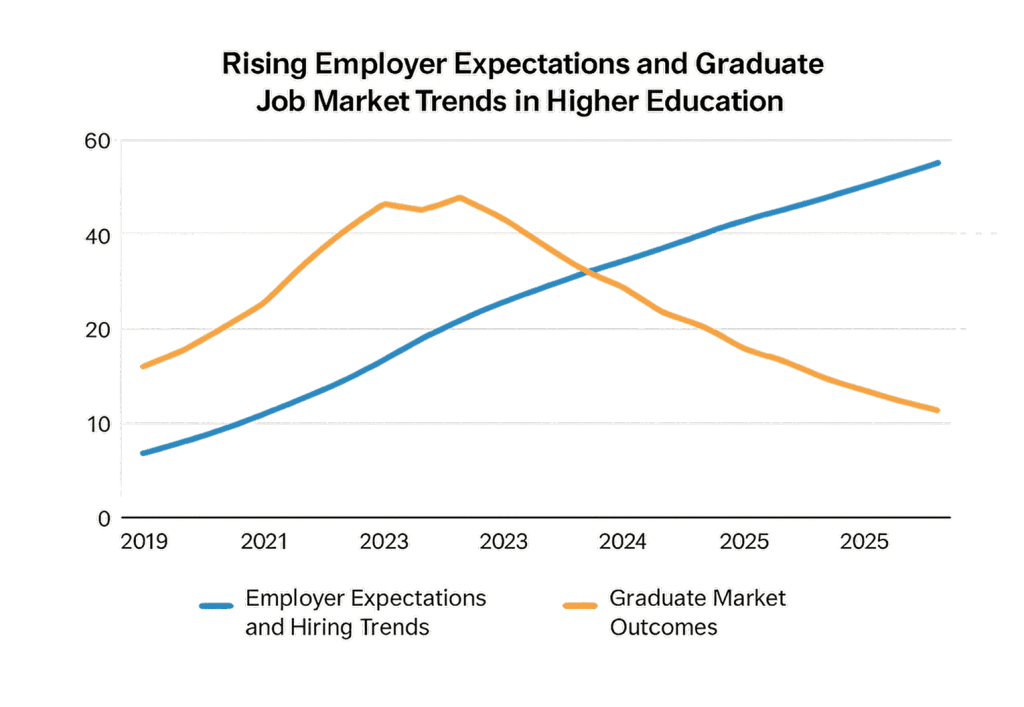
The post-pandemic shift in student expectations, employer demands, and institutional funding models is reshaping what “success” looks like in higher education.
- Students now expect personalized, outcomes-driven support across all majors.
- Employers increasingly demand real-world skills and career readiness—not just degrees.
- Institutional leadership needs clear evidence that career services contribute to retention, enrollment, DEI, and ROI.
At the same time, challenges like staff burnout, limited faculty alignment, and outdated tech make it hard to scale services. That’s why Fall 2025 is a pivotal moment to revisit and elevate your university career planning strategy.
The 7 Biggest Challenges Facing Career Services
1. Proving ROI to Leadership
Challenge: Appointment counts and event sign‑ups aren’t enough. Leadership needs evidence of deeper, measurable impact.
Real-world example: A 2023 UK study shows universities embedding career readiness across curriculum—like the University of Chichester—saw measurable improvements in graduate employment rates. (Source)
WriteSea Pro Tip:
Use our Outcomes Dashboard to:
- Track critical metrics like employment rates, salary bands, and internship participation
- Visualize progress toward institutional goals
- Automatically generate board-ready reports for leadership
Pro move: Connect each metric to strategic university priorities—such as enrollment, retention, and DEI—and build a quarterly “impact scorecard” to share with your dean or director. Explore the Dashboard.
2. Scaling Personalized Support
Challenge: Students expect one-on-one guidance—but teams are stretched too thin.
Real-world example: Shawnee State University implemented Hiration’s AI-powered resume coach, allowing career advisors to support more students with fewer resources. (Source).
WriteSea Pro Tip:
Activate Personalization Automations to:
- Trigger “congratulations” messages post‑acceptance
- Send reminders on resume updates or mock interviews via LMS integration
Action: Segment your student population by major, year, and goals. Use WriteSea-triggered campaigns to deliver relevant content without overloading your advisors.
3. Low Student Engagement or Follow-Through
Challenge: Many students don’t engage with career services until it’s almost too late.
Real-world example: California State University, Sacramento proactively engages students from orientation through graduation, boosting diverse student participation. (Source).
WriteSea Pro Tip:
- Use Early Engagement Campaigns triggered at key moments (freshman orientation, midterms, graduation)
- Include behavior-based nudges based on clicks, login frequency, or event attendance
Action: Roll out a multi-touch email and SMS campaign that spans the academic year to build awareness long before senior year.
4. Limited Faculty Integration
Challenge: Without faculty buy-in, career-ready experiences stay siloed.
Real-world example: Inside Higher Ed highlights several institutions embedding career prep into classes via partnerships between faculty and career centers.. (Source).
WriteSea Pro Tip:
Foster deeper collaboration by:
- Sharing student engagement insights with faculty advisors
- Inviting faculty to co-promote career milestones through academic communications
Action: Identify one course or department to pilot embedded career content in Fall 2025, and use engagement data to scale in Spring 2026.
5. Outdated Tech + Manual Processes
Challenge: Paper processes and siloed systems slow everything down.
WriteSea Pro Tip:
- Connect WriteSea with your LMS to automate appointment reminders
- Flag students with low engagement and prompt outreach in real time
Action: Audit your workflows and convert three manual tasks (e.g., data entry, follow-up emails, reporting) into automated streams by end of semester.
6. Poor Use of Outcome Data
Challenge: Collecting outcome data is pointless if you don’t analyze or share it.
Real-world example: Inside Track shows U.S. public universities leveraging data + tech integration to sharpen career services strategies. (Source).
WriteSea Pro Tip:
- Launch a Graduate Outcomes Tracker for post-grad surveys, salary data, and job placement
- Build dashboards for admissions, advancement, and institutional research teams
Action: Schedule quarterly “data dives” with cross-functional teams to review trends and shape future initiatives.
7. Staff Burnout and Time Constraints
Challenge: Career services teams face unsustainable workloads, risking both staff well-being and program quality.
Real-world example: InsideTrack’s 2025 trends report highlights a growing focus on staff wellness—encouraging institutions to address burnout by streamlining workloads, investing in mental health resources, and automating low-impact tasks. (Source).
WriteSea Pro Tip:
Leverage WriteSea’s engagement insights to:
- Identify repetitive student needs that can be addressed via automation
- Monitor overall usage patterns to inform staffing priorities
- Free up advisors to focus on high-impact, 1:1 student coaching
Action: Conduct a workflow audit to identify three high-effort, low-impact tasks to automate or delegate this semester.

What This Means for University Career Planning in 2025
Addressing these challenges requires strategic investment and cross-campus collaboration. As you plan for Fall 2025 and Spring 2026, here’s your roadmap:
- Review & Audit current programming, tools, data systems, and faculty partnerships
- Partner with admissions, academic affairs & institutional research to align with broader university goals
- Invest in scalable technology and outcome tracking systems
- Automate low-impact tasks to free up valid staff time
- Track and report meaningful student outcomes every quarter
- Monitor advisor wellbeing and workflow capacity
These steps create a resilient, scalable, and impact-focused career services operation—ready to meet both student needs and internal metrics.
Book Your Free Demo
See how WriteSea can help your team re-engage students, track real outcomes, and automate outreach—without the manual lift.
Subscribe to The Write Way
Get weekly strategies, insights, and pro tips—so your team can stay ahead without burning out.
References
- CareersOS (2024) 3 Strategies to Attract Students in 2025 Using Outcome Data. [online] Available at:https://www.careeros.com/resources/3-strategies-to-attract-students-in-2025 [Accessed 21 Jul. 2025].
- (2024) A Framework for Scaling Experiential Learning in Higher Education. [online] Available at:https://practera.com/scaling-experiential-learning-higher-education-framework [Accessed 21 Jul. 2025].
- National Career Development Association (2024) Helping Underserved Students Connect With Career Services. [online] Available at:https://www.ncda.org/aws/NCDA/pt/sd/news_article/557006/_PARENT/CC_layout_details/false [Accessed 21 Jul. 2025].
- Times Union (2024) UAlbany Pushes for More Student Career Readiness Programs. [online] Available at:
- Inside Higher Ed (2024) Four Models of Career Innovation in Higher Ed. [online] Available at:
- InsideTrack (2024) 10 Higher Ed Trends to Watch in 2025. [online] Available at:https://www.insidetrack.org/blog/10-higher-ed-trends-to-watch-in-2025 [Accessed 21 Jul. 2025].
- WriteSea (2025) The New Metrics That Matter for Career Services in 2025. [online] Available at:https://writesea.com/blog/the-new-metrics-that-matter-for-career-services-in-2025 [Accessed 21 Jul. 2025].
- Universities UK (2023) Improving Graduate Employment: Case Studies from Across the Sector. [online] Available at:

Leander Howard II
Leander Howard II is the Co-Founder and Chief Marketing Officer at WriteSea, an AI-powered career services platform transforming how students and job seekers navigate their professional journey. With a background in marketing, finance, and career coaching, Leander brings a unique blend of industry insight and entrepreneurial drive to the higher education space. He’s a passionate advocate for equitable access to career readiness tools and believes career support should be embedded across every student touchpoint. A Georgia State University alumnus, Leander is based in Tulsa, Oklahoma. Outside of work, he enjoys podcasting, running, and spending time with family and friends.