Turn Career Fair Conversations Into Opportunities. Get the Career Fair Kit. Click here.
Gen Z Career Expectations in 2025 and Beyond for Higher Ed
Share this article
In this article


Introducing The Write Way: Your Weekly Career Innovation Digest
Join 1,000+ career services professionals who receive industry news, the latest trends, and insights on AI every single week straight to their inbox.
In 2025, higher education stands at a turning point. Gen Z students—the most diverse, digitally native generation in history—are entering college with sharper expectations than any group before them. They are not content with promises of success; they want proof. For provosts, deans, and career services leaders, this raises a pressing question: how can institutions meet the demands of a generation that equates education with tangible career outcomes?
The answer lies in rethinking the student experience. Career readiness can no longer exist as an optional add-on. It must be embedded into the curriculum, tracked through data, and aligned with the skills employers need. Institutions that succeed in these areas will not only serve their students but also secure long-term enrollment and reputation in a competitive higher ed market.
The Case for Understanding Gen Z’s Career Expectations
Gen Z career expectations reflect broader cultural and economic shifts. According to AACSB, proving measurable readiness is now a top priority for both students and employers (AACSB, 2025). Students are no longer satisfied with activity-based metrics like workshop attendance; they want to know if their investment will translate into meaningful employment.
At the same time, Gen Z brings optimism to higher education. A 2025 Lumina Foundation report shows that most students still believe a degree is worth pursuing, provided that institutions can deliver transparent pathways to careers (Lumina Foundation, 2025).
WriteSea Pro Tip:
Speak to students in the language they value: outcomes. Sharing placement data, alumni stories, and ROI results is more persuasive than emphasizing process alone.
What Gen Z Students Want from Higher Education

ROI and Career Relevance
For Gen Z students, return on investment is not just a financial calculation; it’s the measure of whether their degree leads to opportunity. Students want programs that align with labor market trends, paying close attention to industries like technology, healthcare, and sustainability. If universities cannot show clear pathways from classroom to career, students will look elsewhere.
Embedded Career Preparation
Unlike previous generations, Gen Z does not view career preparation as something separate from academics. Inside Higher Ed highlights the growing demand for institutions to build career services directly into coursework, where students can practice real-world applications while learning (Inside Higher Ed, 2025). Capstone projects, employer-embedded case studies, and curriculum-linked internships are no longer differentiators—they are expectations.
Skills for the Future of Work
Employers are shifting toward skills-based hiring, which means higher ed Gen Z students expect to leave college with transferable competencies: adaptability, problem-solving, digital literacy, and communication. A Johns Hopkins Imagine blog emphasizes that as Gen Z matures, they want institutions to prioritize building resilience and flexibility alongside technical expertise (Johns Hopkins Imagine, 2025).
WriteSea Pro Tip:
Career services should frame programming around “future-ready skills.” Students respond well to clear connections between their coursework and employer expectations.
Shaping Institutional Strategy for Gen Z Career Readiness
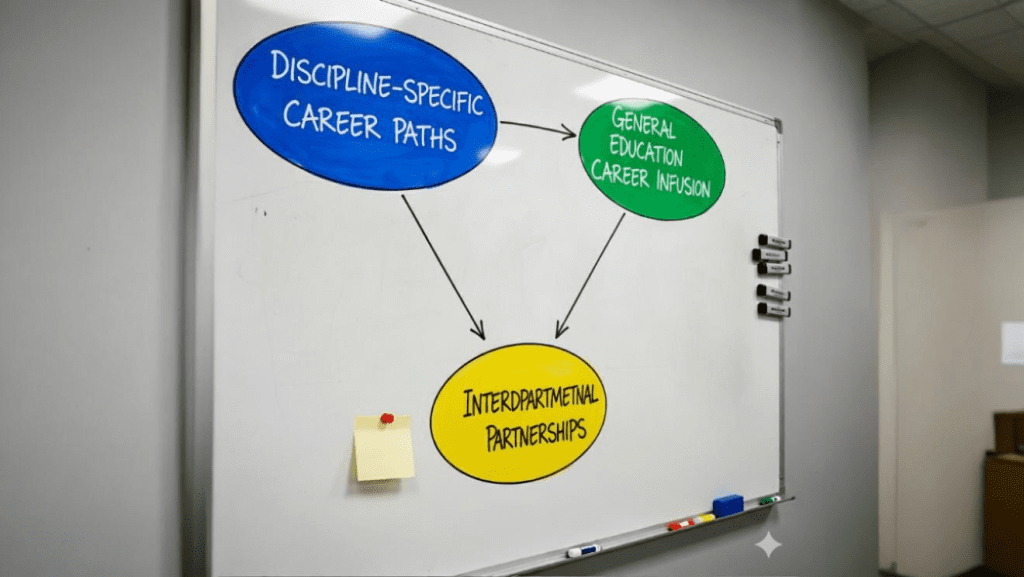
Embed Career Services into the Curriculum
The most successful universities are not treating career services 2025 as an extracurricular offering. Instead, they are weaving career preparation into the academic fabric. Examples include:
- Faculty designing assignments that double as resume-worthy projects.
- Employers co-teaching classes or mentoring students.
- Alumni providing real-world case studies linked to current coursework.
This approach deepens student engagement and demonstrates institutional commitment to outcomes.
Leverage Data to Prove Outcomes
In 2025, tracking outcomes is essential for both recruitment and retention. Students and parents want transparency. Institutions that build data dashboards showing resume improvements, job placements, and alumni success stories stand out in the enrollment marketplace. Leadership teams also benefit, as outcome data supports accreditation, rankings, and funding requests.
WriteSea Pro Tip:
Explore AI-powered tools that streamline outcome tracking. Platforms like WriteSea’s higher education solutions provide career data dashboards that speak to both students and leadership.
Build Inclusive and Accessible Career Services
Gen Z is the most diverse generation yet, which means equity and accessibility are central. Career services must go beyond traditional models, offering multilingual resources, hybrid events, and mobile-first platforms. By meeting students where they are, institutions prove their commitment to inclusivity.
Policy, Enrollment, and Workforce Pressures in 2025

The stakes for higher education have never been higher. Enrollment declines continue across many regions, forcing universities to compete for fewer students. At the same time, employers are demanding stronger skill alignment, and policymakers are holding institutions accountable for measurable outcomes.
This convergence creates both pressure and opportunity. Institutions that demonstrate career relevance can attract skeptical students and reassure policymakers. Those that fail to adapt risk declining enrollment and diminished trust.
WriteSea Pro Tip:
Frame career services as central to institutional mission. When positioned as a driver of enrollment, retention, and outcomes, career services gain the visibility and funding they need.
FAQs
What are the top Gen Z career expectations in 2025?
Students expect ROI from their degrees, embedded career preparation, and future-ready skills. They also want transparency on career outcomes before committing to a program.
How can universities prove career readiness outcomes?
By integrating career preparation into coursework and using data dashboards to demonstrate measurable success, universities can show clear ROI to both students and leadership.
Why is career integration critical for enrollment in 2025?
With ongoing enrollment declines, institutions that prove value through career outcomes attract and retain students more effectively than those relying on legacy models.
Conclusion: Building Conclusion: Meeting the Moment Sustainable Career Integration
Gen Z career expectations in 2025 reflect a generational shift that higher education cannot ignore. Students want proof of ROI, career services embedded in academics, and future-ready skills that match employer demand. The message is clear: institutions that adapt will thrive; those that don’t risk irrelevance.
For higher education leaders, this is not just about meeting expectations—it’s about seizing the opportunity to lead. By embedding career readiness, leveraging outcome data, and prioritizing inclusivity, institutions can build trust with Gen Z and secure their place in the future of higher education.
Is your campus
Ready for Gen Z expectations? Book a demo to see how we make career readiness seamless—and subscribe to The Write Way Newsletter for weekly insights that help your team support career-ready students.
Book Your Free Demo
See how WriteSea can help your team re-engage students, track real outcomes, and automate outreach—without the manual lift.
Subscribe to The Write Way
Get weekly strategies, insights, and pro tips—so your team can stay ahead without burning out.
References
- AACSB. (2025). Prove It: Measuring Gen Z’s Career Readiness. Available at: https://www.aacsb.edu/insights/articles/2025/04/prove-it-measuring-gen-zs-career-readiness (Accessed 5 September 2025).
- Inside Higher Ed. (2025). Helping Gen Z Navigate Future Careers. Available at:
- Johns Hopkins Imagine. (2025). Gen Z Is Growing Up, So Are Our Career Priorities. Available at: https://imagine.jhu.edu/blog/2025/05/21/gen-z-is-growing-up-so-are-our-career-priorities/ (Accessed 5 September 2025).
- Lumina Foundation. (2025). Gen Z Students Are Optimistic About Higher Education—Let’s Prove Them Right. Available at: https://www.luminafoundation.org/news-and-views/gen-z-students-are-optimistic-about-higher-education-lets-prove-them-right/ (Accessed 5 September 2025).

Leander Howard II
Leander Howard II is the Co-Founder and Chief Marketing Officer at WriteSea, an AI-powered career services platform transforming how students and job seekers navigate their professional journey. With a background in marketing, finance, and career coaching, Leander brings a unique blend of industry insight and entrepreneurial drive to the higher education space. He’s a passionate advocate for equitable access to career readiness tools and believes career support should be embedded across every student touchpoint. A Georgia State University alumnus, Leander is based in Tulsa, Oklahoma. Outside of work, he enjoys podcasting, running, and spending time with family and friends.