How Career Centers Can Help Students Turn Classroom Skills Into Career Opportunities
Share this article
In this article


Introducing The Write Way: Your Weekly Career Innovation Digest
Join 1,000+ career services professionals who receive industry news, the latest trends, and insights on AI every single week straight to their inbox.
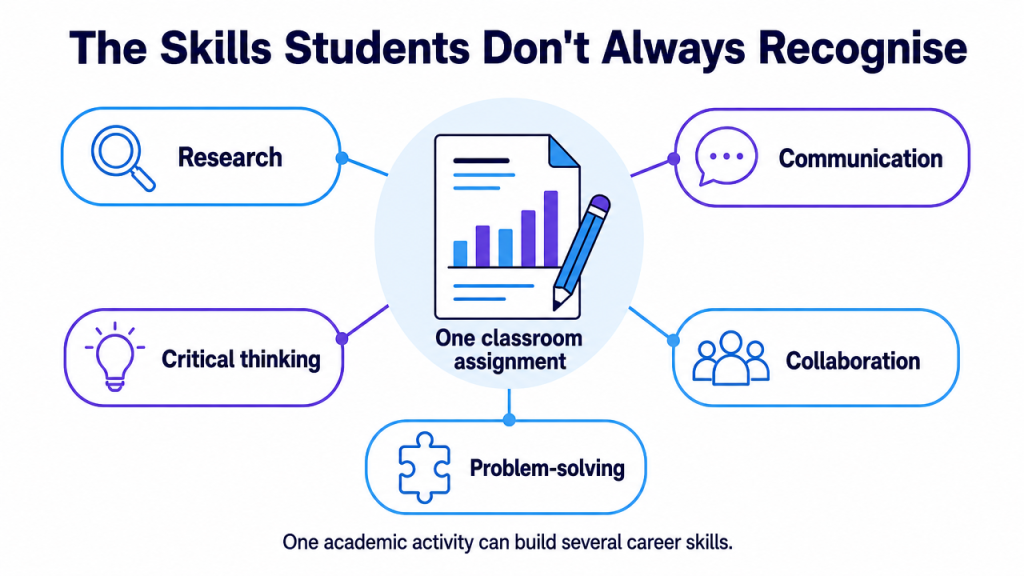
A student can spend an entire semester researching a public health issue, analysing data, collaborating with classmates and presenting recommendations. Yet when asked what skills they bring to an employer, they might struggle to name anything beyond communication and teamwork.
The problem isn’t necessarily a lack of experience. It’s that students don’t always recognise the professional value of the work they’re already doing.
This creates a challenge for career services teams. Students need more than advice on choosing a career or formatting a resume. They need help understanding what they have learned, identifying the skills they’ve developed and explaining how those skills apply outside the classroom.
This is becoming increasingly important as employers place greater emphasis on what candidates can actually demonstrate.
According to the National Association of Colleges and Employers (NACE), 70% of employers participating in its Job Outlook 2026 survey reported using skills-based hiring for entry-level positions. However, fewer than 40% of graduating seniors said they were familiar with the term skills-based hiring. [1]
For career centers, this presents an opportunity to help students understand the connection between their education and the workplace.
By working more closely with academic departments, faculty and students, career services teams can help make that connection clearer and more consistent.
Here are five ways institutions can approach this work.
1. Why students struggle to identify their skills
Students often think about their education in terms of subjects, assignments, grades and qualifications. They know what they studied, but may not have considered the abilities they used to complete their work.
A biology student might describe a laboratory assignment as an exercise in following instructions. They may overlook the experimental design, observation, data collection and analytical thinking involved.
Similarly, a business student might describe a group presentation as a class requirement without recognising the research, problem-solving, collaboration and communication it required.
These are not necessarily skills students lack. They are skills they haven’t learned to recognise or explain.
There are several reasons this happens.
Students may not see the connection between academic work and employment.
When students think about career preparation, they often prioritise internships, part-time jobs and extracurricular activities. Coursework can feel separate from professional development, even when it involves activities that are directly relevant to workplace responsibilities.
They may know the skill but not the language employers use.
A student might say they are good at organising information, while an employer describes the same capability as research, data analysis or information management. Helping students understand these connections gives them a more useful vocabulary for discussing their experience.
They may underestimate what they have accomplished.
Without workplace experience, students can assume that their academic projects are not substantial enough to include on a resume or discuss in an interview. In reality, a well-developed academic project can provide useful evidence of their capabilities.
NACE’s career readiness framework offers institutions a helpful starting point. Its competencies include communication, critical thinking, teamwork, professionalism, leadership, technology and career self-development, with each supported by examples of behaviours students can demonstrate. [2]
Career coaches can use this framework to help students look beyond the name of an assignment and consider what they actually did.
The goal is to change the conversation from “What classes have you taken?” to “What have you learned to do, and how can you demonstrate it?”
2. Mapping coursework to career skills
Once students begin recognising the skills within their academic experiences, the next step is helping them identify where those skills appear across their coursework.
This is where career centers can benefit from stronger collaboration with faculty and academic departments.
Faculty members understand the learning objectives of their courses. Career services professionals understand how employers describe and evaluate skills. Bringing those perspectives together can help students see the professional relevance of their education.
A practical starting point is to map common academic activities against transferable skills.
Consider how different disciplines develop capabilities that can be applied in a range of professional environments:
| Academic discipline or activity | Skills students may develop | Possible professional applications |
|---|---|---|
| Biology laboratory work | Data collection, observation, research, attention to detail | Research, healthcare, quality assurance |
| Business case studies | Problem-solving, financial analysis, decision-making | Business operations, consulting, management |
| Group research projects | Collaboration, communication, project coordination | Project management, marketing, administration |
| Computer science assignments | Technical problem-solving, programming, testing | Software development, IT, data analysis |
| English and humanities essays | Written communication, critical analysis, research | Communications, policy, publishing |
| Public speaking and presentations | Verbal communication, persuasion, information delivery | Sales, training, leadership, client relations |
The purpose isn’t to suggest that completing one assignment automatically qualifies someone for a particular job. Rather, it helps students understand the capabilities they have practised and where those capabilities might be useful.
Career centers can make this process more consistent through a few practical steps:
- Collaborate with faculty: Ask departments to identify the skills students are expected to demonstrate through major assignments and assessments.
- Develop a shared skills vocabulary: Use consistent descriptions across academic departments and career services.
- Create course-to-career examples: Give students examples of how common academic activities can translate into professional capabilities.
- Build reflection into academic experiences: Encourage students to identify the skills they used after completing projects, presentations and group assignments.
This doesn’t require every department to redesign its curriculum. It starts with making existing learning outcomes more visible.
When students understand the capabilities they are developing, they have a stronger foundation for communicating their value to employers.
3. Translating academic projects into resumes
Recognising a skill is one thing. Communicating it effectively on a resume is another.
Students frequently describe academic projects by listing what they were asked to do rather than explaining what they accomplished or what capabilities they demonstrated.
For example:
Completed a group assignment on consumer behaviour.
This tells an employer what the student worked on, but very little about their contribution.
A stronger description might be:
Collaborated with a four-person team to research consumer purchasing behaviour, analyse survey findings and present recommendations based on the results.
The second version gives an employer more information. It demonstrates research, collaboration, data interpretation and communication.
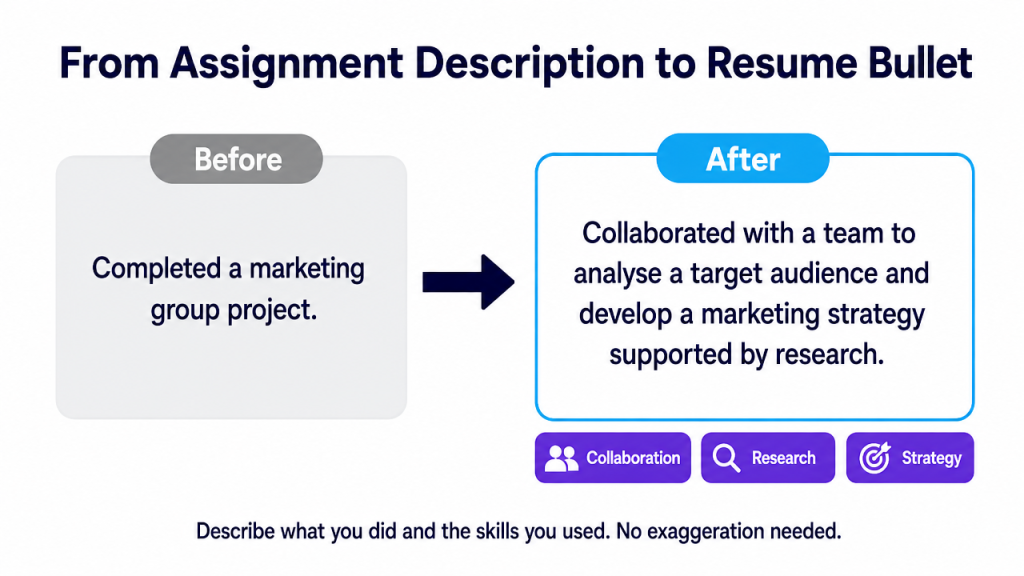
The difference is not about making an academic assignment sound more impressive than it was. It’s about describing the work accurately and showing the skills involved.
Career coaches can help students develop stronger resume descriptions by asking four questions:
- What was the project or assignment?
- What were you responsible for?
- What actions did you take?
- What was the result, outcome or evidence of your contribution?
This approach helps students move beyond generic skill lists and develop descriptions supported by actual experience.
For example:
| Student’s original description | Stronger skills-based description |
|---|---|
| Wrote a research paper for a psychology class. | Researched psychological theories, evaluated academic literature and developed a written analysis of human behaviour. |
| Completed a marketing group project. | Collaborated with a team to analyse a target audience and develop a marketing strategy supported by research. |
| Worked on a computer science assignment. | Developed and tested a software application, identified technical issues and refined the solution through debugging. |
| Presented a history project. | Evaluated historical sources, developed an evidence-based argument and presented research findings to an academic audience. |
Students should also understand that not every academic project belongs on every resume. The most relevant examples are those that help demonstrate capabilities connected to the opportunity they’re pursuing.
This is where individual career coaching becomes valuable. A coach can help students select relevant experiences, refine their descriptions and tailor their resumes to different roles.
NACE’s 2026 employer research reinforces the importance of this approach. Employers have indicated that candidates should provide examples of their skills rather than simply listing them. [3]
A resume should therefore do more than tell an employer what a student knows. It should give them a reason to believe the student can apply that knowledge.
4. Connecting skills to employers and jobs
Once students can identify and describe their skills, they need to understand where those capabilities fit in the job market.
This is an important part of career coaching because students don’t always know which opportunities align with their academic experiences.
A student studying sociology, for example, might initially assume their options are limited to social services or further academic study. However, their research, communication, interviewing and analytical skills may also be relevant to roles in human resources, community engagement, market research and public policy.
The challenge is helping students understand how to make these connections without overstating their experience or suggesting that every skill is equally relevant to every role.
Career centers can help students approach this process in three ways.
Start with the job description.
Encourage students to examine actual job postings and identify the capabilities employers request. Rather than focusing only on job titles or degree requirements, students should look for responsibilities involving research, communication, analysis, organisation, problem-solving or technical knowledge.
Compare employer requirements with existing experience.
Students can then review their coursework, projects and other experiences to identify examples that demonstrate relevant capabilities.
For instance, a student applying for an entry-level research position may not have held a formal research job. However, an academic project involving literature reviews, data analysis and written findings could provide relevant evidence of their preparation.
Help students explain the connection.
Students should be able to describe why an experience is relevant to a particular opportunity. This is especially important during interviews, where they may be asked to explain how they approached a problem, worked with others or applied their knowledge.
Career coaches can support this through mock interviews, job-description analysis, resume reviews and practical exercises that help students develop examples of their skills.
NACE’s 2026 Student Survey found that students who were familiar with skills-based hiring were more likely to include skills gained through academic classes, internships and co-curricular activities on their resumes. [4]
That finding highlights the importance of career education itself. Helping students understand how hiring works can influence how they present the experiences they already have.
The aim is not to push students towards a particular job simply because their skills appear to match. It is to help them make more informed decisions about where their education, interests and capabilities could take them.
5. Building a repeatable campus process
Helping individual students translate their academic experiences into career opportunities is valuable. But institutions can make a greater difference when this support becomes part of a consistent campus-wide approach.
Without a shared process, students may receive very different levels of career guidance depending on their department, year of study or whether they actively seek help from the career center.
A more coordinated approach makes it easier for students to develop and communicate their skills throughout their education.
Career services teams can begin by establishing a simple process that connects academic learning with career preparation.
1. Identify skills within academic programmes.
Work with faculty and department leaders to understand the capabilities students develop through coursework, assessments, research and practical assignments.
2. Introduce skills reflection at key points.
Encourage students to reflect on what they have learned after completing significant projects, presentations, placements and other academic activities. This helps them build a record of their experiences rather than trying to remember everything when they begin applying for jobs.
3. Connect students with career coaching.
Career coaches can help students translate their experiences into resume descriptions, interview examples and professional language. This support should be available before students reach their final semester.
4. Give students opportunities to practise.
Resume workshops, mock interviews, career-readiness activities and employer engagement events allow students to practise communicating their skills and receiving feedback.
5. Review participation and outcomes.
Institutions can evaluate whether students are engaging with these resources and whether they are becoming more confident in identifying and demonstrating their capabilities.
This process also creates opportunities for collaboration across departments. Academic advisors, faculty members, career coaches and student success teams can all contribute to helping students understand how their education connects to their future.
Importantly, institutions should consider how they will evaluate progress.
Useful indicators might include:
- Student participation in career coaching and skills workshops.
- The number of academic departments incorporating career reflection activities.
- Student confidence in identifying and describing transferable skills.
- Improvements in resume and interview preparation assessments.
- Student feedback on the relevance of career services support.
- Graduate employment and continuing education outcomes, where reliable data is available.
These measures provide a more complete picture than workshop attendance alone. They help institutions understand whether students are gaining the knowledge and support needed to communicate their capabilities.
The process does not need to be complicated. It needs to be consistent, accessible and connected to the academic experiences students are already having.
Final thought
Students don’t necessarily need to wait until they have completed an internship or secured their first job to start building a professional story.
Much of the groundwork is already happening in their classrooms. They are researching, analysing, writing, presenting, solving problems and working with others. What they often need is help recognising the value of those experiences and explaining them in a way employers can understand.
Career centers have an important role in making that connection.
By working alongside faculty, academic advisors and students, career services teams can help turn everyday academic experiences into evidence of career readiness.
The opportunity is to make career development part of the student experience throughout their education, not simply something that begins when graduation approaches.
Help Your Career Services Team Do More
Supporting students throughout their career journey takes time, coordination and the right resources.
WriteSea works with 60+ colleges, universities, workforce organizations and government agencies, helping career services teams strengthen the way they support students and manage career development.
See how WriteSea can support your team’s career services operations and help reduce manual administrative work.
The WriteWay
Stay informed. Keep moving forward.
The WriteWay brings you practical insights, career services strategies and ideas to help you better support students and strengthen career readiness.

Brandon Mitchell
References
- National Association of Colleges and Employers (NACE). (January 23, 2026). Skills-Based Hiring Grows, but College Students Don’t Fully Understand It.
- National Association of Colleges and Employers (NACE). What Is Career Readiness?.
- National Association of Colleges and Employers (NACE). (May 28, 2026). Employers Give New College Grads a Passing Grade on Job Readiness.
- Kevin Gray, National Association of Colleges and Employers (NACE). (August 6, 2026). Awareness of Skills-Based Hiring Drives Students to Upgrade Resumes.