

WriteSea

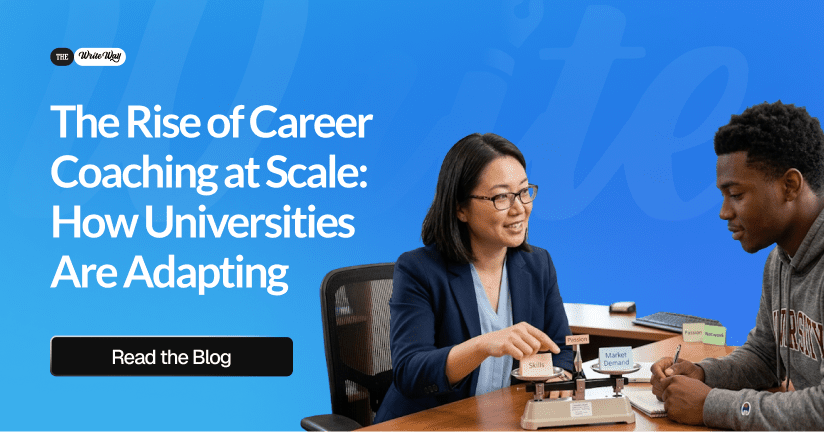
The Rise of Career Coaching at Scale: How Universities Are Adapting

Share this article

In this article

image 1
image

Introducing The Write Way: Your Weekly Career Innovation Digest

Join 1,000+ career services professionals who receive industry news, the latest trends, and insights on AI every single week straight to their inbox.

New Banner 63
Career coaching has become one of the most in-demand services on campus.

Students aren’t just looking for degrees.
 
They’re looking for direction.

They want help navigating:

  • Career paths
  • Job markets
  • Applications
  • Real-world decisions

And they want that support early, consistently, and at scale.

But here’s the challenge:

Most career centers were never designed to meet that level of demand.

The Growing Demand for Career Coaching

Across higher education, demand for career services has surged.

More students are seeking guidance—not just in their final year, but throughout their entire academic journey.

Research from the National Association of Colleges and Employers shows that students increasingly expect career support to be embedded into their university experience, not treated as an optional service (NACE, 2025).

At the same time, Strada Education Foundation research highlights that students are prioritizing career outcomes more than ever when evaluating their education choices (Strada Education Foundation, 2023).

This creates a clear expectation:

Career support isn’t a bonus.

It’s a core part of the value students believe they are paying for.

Advising No Longer Scales

Traditional career coaching models are built around 1:1 appointments.

And while those sessions are valuable, they don’t scale.

A single advisor can only support a limited number of students per day.

Meanwhile, thousands of students may need support at the same time.

Coverage from Inside Higher Ed highlights how institutions are struggling to meet growing demand for career services without significantly increasing staff capacity (Inside Higher Ed, 2024).

This creates a bottleneck:

  • High demand
  • Limited capacity
  • Uneven access to support

The result?

Some students get personalized guidance.

Many don’t.

And that gap directly impacts outcomes.

The Shift Toward Scalable Coaching Models

To address this, universities are rethinking how career coaching is delivered.

Instead of relying solely on 1:1 advising, institutions are introducing scalable coaching models.

One of the most effective approaches is group coaching.

Group sessions allow career teams to:

  • Reach more students at once
  • Deliver structured, repeatable guidance
  • Encourage peer learning and shared experiences

Students benefit from hearing common questions, challenges, and strategies from others navigating similar paths.

And institutions benefit from significantly increasing reach—without increasing headcount.
This doesn’t replace 1:1 support.

It rebalances it.

1:1 becomes high-impact, targeted support.

Group coaching becomes the foundation.

AI-Assisted Coaching Is Expanding Access

44493
Beyond group models, AI is starting to play a meaningful role in scaling career support.

AI-assisted coaching tools can:

  • Provide instant feedback on resumes
  • Guide students through application processes
  • Offer personalized recommendations
  • Answer common career questions in real time

This allows students to access support on demand, not just during limited office hours.

And it frees up advisors to focus on higher-value interactions.

According to research from the World Economic Forum, digital and AI-driven tools are increasingly shaping how education systems prepare students for the future of work (World Economic Forum, 2023).

In this model:

  • AI handles repetition
  • Advisors handle complexity

Together, they create a more scalable, responsive system.

Scaling Impact Without Losing Quality

One of the biggest concerns institutions face when scaling coaching is quality.

More reach often raises questions about effectiveness.

But scaling doesn’t have to mean dilution.

In fact, when done well, it can improve outcomes.

The key is structure.

Effective scalable coaching models include:

  • Clear pathways for student progression
  • Consistent, repeatable frameworks
  • Visibility into student engagement and readiness
  • Data to track outcomes over time

This allows institutions to move from reactive support to proactive guidance.

Instead of waiting for students to book appointments, career teams can guide them at every stage of their journey.

What This Means for Career Centers

This shift is redefining the role of career centers.

They are no longer just service providers.

They are becoming systems builders.

Teams are being asked to:

  • Support more students
  • Deliver measurable outcomes
  • Integrate with institutional strategy
  • Demonstrate impact at scale

And they need the infrastructure to do it.

Because without systems, scaling becomes reactive.

With systems, scaling becomes intentional.

Where WriteSea Fits In

Scaling career coaching requires more than good intentions.

It requires visibility, structure, and the ability to measure progress across thousands of students.

WriteSea helps institutions:

  • Track student readiness across the full journey
  • Standardize coaching frameworks and feedback
  • Surface early indicators of career success
  • Measure engagement, skills, and outcomes in real time

👉 Book a personalized demo: https://writesea.com/request-demo/

👉 Explore past webinars and insights: https://writesea.com/webinars/

WriteSea Pro Tip:

If career coaching only works for the students who book appointments, it’s not scalable. The goal is to reach every student—not just the most proactive ones.

Final Thought

Career coaching is no longer a side service.

It’s becoming a core expectation.
Students want guidance.

Institutions are expected to deliver it.

And in 2026, the universities that succeed won’t be the ones offering more appointments.

They’ll be the ones building systems that scale.

FAQs

Why is demand for career coaching increasing?

Students are placing greater emphasis on career outcomes and want ongoing guidance throughout their academic journey.

What is scalable career coaching?

It includes models like group coaching, structured programs, and AI-assisted tools that allow institutions to support more students efficiently.

Does group coaching replace 1:1 advising?

No. It complements it. Group coaching handles foundational guidance, while 1:1 focuses on personalized support.

How does AI support career coaching?

AI tools provide instant, scalable support for tasks like resume feedback, job matching, and answering common career questions.

Book Your Free Demo

See how WriteSea helps your team measure career outcomes, identify risk early, and improve engagement without the manual lift.

Subscribe to The Write Way

Get weekly strategies, insights, and pro tips on career readiness, outcomes measurement, and scalable systems for higher ed teams.

References

  1. National Association of Colleges and Employers (NACE). (2025). First Destinations for the College Class of 2024. https://www.naceweb.org/docs/default-source/default-document-library/2025/publication/free-report/nace-first-destinations-college-class-of-2024.pdf
  2. Strada Education Foundation. (2023). The Value of Community Colleges: Recent Students’ Motivations and Outcomes. https://www.strada.org/reports/the-value-of-community-colleges-recent-students-motivations-and-outcomes
  3. Inside Higher Ed. (2024). Four models of career innovation in higher ed. https://www.insidehighered.com/news/student-success/life-after-college/2024/12/03/four-models-career-innovation-higher-ed
  4. World Economic Forum. (2023). Future of Jobs Report. https://www.weforum.org/reports/the-future-of-jobs-report-2023
cropped image 4

Leander Howard II

Leander Howard II is the Co-Founder and Chief Marketing Officer at WriteSea, an AI-powered career services platform transforming how students and job seekers navigate their professional journey. With a background in marketing, finance, and career coaching, Leander brings a unique blend of industry insight and entrepreneurial drive to the higher education space. He’s a passionate advocate for equitable access to career readiness tools and believes career support should be embedded across every student touchpoint. A Georgia State University alumnus, Leander is based in Tulsa, Oklahoma. Outside of work, he enjoys podcasting, running, and spending time with family and friends.

Ensure Every Student is
Career Ready

If you would like to be featured in WriteSea’s Executive Interview Series, please fill out this form.

Join The WritersBloc

Your Information