

WriteSea

Students Want Jobs, Not Workshops: Rethinking Career Programming

Share this article

In this article

image 1
image

Introducing The Write Way: Your Weekly Career Innovation Digest

Join 1,000+ career services professionals who receive industry news, the latest trends, and insights on AI every single week straight to their inbox.
New Banner 58
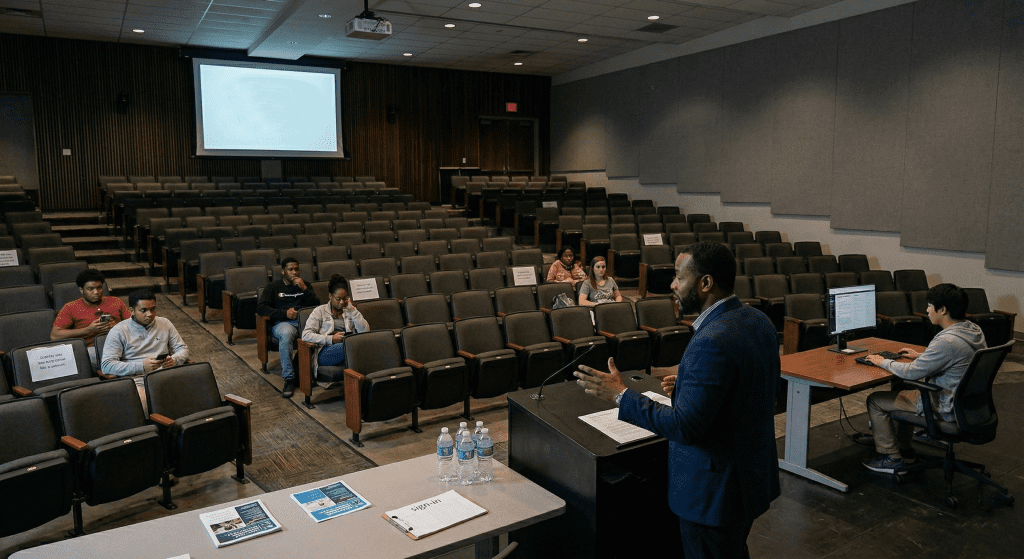
Career workshops have long been a core part of university career services.

Resume sessions.

Interview prep workshops.

Networking events.

But across campuses, something is changing.

Students are attending fewer sessions, engaging less consistently, and increasingly questioning how these experiences translate into real career outcomes.

At the same time, institutions are facing growing pressure to demonstrate employability results—not just participation.

We’re not being asked to run more programs.

We’re being asked to prove outcomes.

This creates a critical shift for career services teams:

It’s no longer enough to deliver programming.

It must deliver measurable progress.

Why Workshop Attendance Is Declining

Gemini Generated Image 4jqjdp4jqjdp4jqj
Students today are navigating a far more complex transition into the workforce.

Rapid changes in hiring practices, the rise of AI-driven recruitment tools, and increased competition for entry-level roles have raised expectations around career preparation.

Research shows that while career workshops can improve short-term confidence and career decision-making, their impact is often limited without sustained, applied support (Taylor & Francis, 2023).

At the same time, broader engagement trends suggest that many students are not consistently participating in traditional career programming.

A report by the Urban Institute highlights that career services often struggle with uneven student engagement, particularly among students who may benefit most from support (Urban Institute, 2024).

This suggests that the issue is not awareness.

It’s relevance.

Career services hasn’t developed an engagement problem.

It’s developed a relevance problem.

Students are asking:

  • Is this worth my time?
  • Will this actually help me get hired?

What Students Actually Expect from Career Support

Student expectations around career services have evolved significantly.

Today’s students are not just looking for information—they are looking for progress.

Research on career interventions shows that structured, applied career development experiences are more effective in improving employability outcomes than passive learning formats (SAGE Journals, 2022).

Students increasingly expect:

  • personalized feedback
  • real-world application
  • clear signals of improvement
  • support aligned to actual hiring processes

This reflects a broader shift in how students view higher education.

Career services is no longer a “nice-to-have” resource.

It is a core driver of employability outcomes.

Shifting from Events to Measurable Outcomes

One of the biggest challenges facing career services today is measurement.

Most institutions still track:

  • event attendance
  • workshop participation
  • student satisfaction

But those metrics no longer reflect institutional expectations.

The question is no longer how many students attended.

It’s how many became employable.

Research on career development programs emphasizes the importance of tracking outcomes such as skill development, career readiness, and employment progression rather than just participation (Kontagora Journal, 2025).

This requires a shift from:

activity-based reporting

to

outcome-based measurement

WriteSea Pro Tip:

The most valuable career programs are not the ones with the highest attendance—they are the ones that produce measurable student progress.

Designing High-Impact Career Interventions

Gemini Generated Image 4jqjdp4jqjdp4jqj
If workshops alone are not enough, what works better?

Evidence points toward experiential and applied career development models.

A 2025 study on post-pandemic career education found that integrating practical experiences—such as mock interviews, real-world simulations, and applied career tasks—significantly improves student engagement and readiness (MDPI, 2025).

High-impact interventions include:

  • mock interviews with structured feedback
  • resume scoring and revision systems
  • job search simulations
  • employer-informed skill assessments

These approaches move beyond information delivery.

They focus on skill development, performance, and readiness.

Tracking Real Engagement Metrics

As career services evolve, so must the way engagement is measured.

Institutions are beginning to move toward metrics such as:

  • skill progression
  • interview readiness
  • resume quality improvement
  • job placement outcomes

Research on student engagement highlights that meaningful engagement is not defined by participation alone, but by the depth and impact of the experience (University of the Free State, 2025).

Because:

A student attending a workshop is not the same as a student becoming job-ready.

The Future of Career Programming

Career services is entering a new phase.

Students are no longer satisfied with:

  • one-off workshops
  • general advice
  • passive learning

They are looking for:

  • structured pathways
  • real-world preparation
  • measurable progress
  • outcomes they can clearly see

This shift requires more than better programming.

It requires rethinking career services as a system—not a series of events.

Institutions that adapt will move beyond delivering workshops.

They will build career readiness infrastructure that supports every student.

And in doing so, they won’t just improve engagement—

They will improve outcomes.

Book Your Free Demo

See how WriteSea helps your team measure career outcomes, identify risk early, and improve engagement without the manual lift.

Subscribe to The Write Way

Get weekly strategies, insights, and pro tips on career readiness, outcomes measurement, and scalable systems for higher ed teams.

References

  1. Taylor & Francis. (2023). Effectiveness of career guidance workshops on career self-efficacy. https://doi.org/10.1080/02673843.2023.2281421
  2. Urban Institute. (2024). Career Services Strategies to Advance Equity. https://www.urban.org/sites/default/files/2024-10/Career%20Services%20Strategies%20to%20Advance%20Equity.pdf
  3. SAGE Journals. (2022). Career interventions for university students: A systematic review. https://journals.sagepub.com/doi/10.1177/10384162221100460
  4. MDPI Education Sciences. (2025). Redesigning career development in higher education. https://doi.org/10.3390/educsci15070895
  5. Kontagora International Journal of Educational Research. (2025). Career services and employability outcomes. https://fuekjournals.org/index.php/kijer/article/download/73/74/268
  6. University of the Free State. (2025). National Student Engagement Report. https://www.ufs.ac.za/docs/default-source/2025-web-documents/student-engagement-national-report_2025_.pdf
cropped image 4

Leander Howard II

Leander Howard II is the Co-Founder and Chief Marketing Officer at WriteSea, an AI-powered career services platform transforming how students and job seekers navigate their professional journey. With a background in marketing, finance, and career coaching, Leander brings a unique blend of industry insight and entrepreneurial drive to the higher education space. He’s a passionate advocate for equitable access to career readiness tools and believes career support should be embedded across every student touchpoint. A Georgia State University alumnus, Leander is based in Tulsa, Oklahoma. Outside of work, he enjoys podcasting, running, and spending time with family and friends.

Ensure Every Student is
Career Ready

If you would like to be featured in WriteSea’s Executive Interview Series, please fill out this form.

Join The WritersBloc

Your Information