Introduction
Higher education leaders are being asked to navigate increasing complexity.
Student engagement challenges.
Budget constraints.
Leadership turnover.
AI transformation.
Staff burnout.
Growing pressure to demonstrate student success outcomes.
But according to
Raphaella Prange, Vice President for Student Affairs at Maryville University of Saint Louis, one of the biggest barriers institutions face is not a lack of talent.
It is misalignment.
In this fireside chat hosted by
Brandon Mitchell, Co-Founder & CEO of WriteSea, the discussion explored what it actually takes to build high-functioning senior teams in higher education and why leadership alignment directly impacts the student experience.
The conversation covered:
- Organizational transformation
- Strategic planning
- Change management
- Trust-building
- Leadership development
- Zero-based budgeting
- AI readiness
- Staff engagement
- And the future of student affairs leadership
What emerged was a practical conversation about how institutions can move from fragmented operations toward more collaborative, data-informed, and student-centered leadership cultures.
“Senior leadership teams are rarely held back by a lack of talent. More often, the challenge is alignment.”
— Brandon Mitchell, Co-Founder & CEO, WriteSea
🎥 Missed it live?
Watch the recording .
Meet the Experts
🔹 Raphaella Prange — Vice President for Student Affairs, Maryville University of Saint Louis
Raphaella Prange is the Vice President for Student Affairs at Maryville University of Saint Louis and a higher education executive with more than 27 years of leadership experience across student affairs, institutional strategy, and organizational transformation.
As a nationally recognized thought leader, Raphaella’s work focuses on inclusive excellence, trauma-informed leadership, AI integration in higher education, and next-generation student success. She has spent more than 15 years serving as a Chief Student Affairs Officer and President’s Cabinet member, leading strategic initiatives across enrollment management, crisis leadership, governance, fundraising, and institutional culture.
A first-generation Latina scholar-practitioner, Raphaella is known for her mission-driven approach to leadership and her commitment to building university environments where students can thrive academically, professionally, and personally. She regularly speaks and writes on leadership, student success, and the future of higher education.
🔹 Brandon Mitchell — Co-Founder & CEO, WriteSea
Brandon Mitchell is a technology entrepreneur, executive coach, and investor, dedicated to revolutionizing the career services and recruitment industry. As the Co-Founder & CEO of WriteSea, he is driving innovation in AI-powered career mobility solutions, helping job seekers and employers connect more effectively.
With a background in technology consulting at PricewaterhouseCoopers (PwC), Brandon has advised Fortune 500 companies, including KKR, Deutsche Bank, and Morgan Stanley, on complex technology and wealth management solutions. His expertise spans SaaS sales, executive leadership, and public speaking.
Brandon has been featured in Forbes, Yahoo Finance, Earn Your Leisure, and Black Wealth Renaissance. He is also a passionate advocate for financial literacy, career development, and generational wealth, frequently speaking on these topics.
He holds a degree in Finance, Economics, and Management Information Systems from SUNY Plattsburgh and is certified in project management and agile methodologies.
Why Leadership Alignment Matters More Than Ever
Higher education institutions are under increasing pressure to operate faster, collaborate better, and demonstrate measurable student outcomes.
But when leadership teams operate in silos, progress slows.
Student support becomes fragmented.
Decision-making becomes reactive instead of strategic.
And students ultimately feel the consequences.
Throughout the conversation, both Brandon and Raphaella emphasized that leadership alignment is not just an operational issue. It directly affects the student experience.
“The student experience affects leadership alignment whether they see it or they don’t.”
— Brandon Mitchell, Co-Founder & CEO, WriteSea
At Maryville University, Raphaella quickly realized that transformation would require more than restructuring teams or implementing new systems.
It would require rebuilding clarity, trust, and shared ownership across the division.
The Listening Tour Strategy: Building Trust Before Change
Before officially starting in her role, Raphaella began making campus visits months in advance.
She conducted listening tours with staff across the division to better understand:
- operational challenges
- leadership gaps
- communication breakdowns
- and institutional misalignment
What she discovered was revealing.
Many teams:
- lacked clear KPIs
- were not using data consistently
- had little visibility into strategic priorities
- and in some cases, barely knew colleagues across departments.
“People were really hungry for clarity.”
— Raphaella Prange, Vice President for Student Affairs at Maryville University of Saint Louis
The listening tours became the foundation for organizational transformation because they allowed leadership decisions to emerge from lived institutional realities rather than assumptions.
Raphaella emphasized that new leaders often make the mistake of arriving with solutions before fully understanding the culture they are entering.
“You cannot make decisions in a vacuum.”
— Raphaella Prange, Vice President for Student Affairs at Maryville University of Saint Louis
Instead of immediately imposing change, she focused first on:
- listening
- understanding patterns
- identifying trust gaps
- and learning where alignment had broken down.
This created the psychological safety necessary for future innovation and collaboration.
Why Strategic Plans Fail When They Become “Shelf Documents”
One of the strongest themes throughout the webinar was the failure of many institutional strategic plans to move beyond high-level vision statements.
When Raphaella arrived at Maryville, she discovered there was no Student Affairs strategic plan in place.
Even broader institutional plans lacked:
- operational ownership
- measurable action steps
- accountability structures
- and meaningful visibility across teams.
Rather than treating strategic planning as a leadership-only exercise, her team expanded the process across the entire division.
More than 100 staff members participated in shaping the Student Affairs strategic plan.
The result was a more collaborative and actionable framework connected directly to institutional priorities.
“Strategic planning is a living document.”
— Raphaella Prange, Vice President for Student Affairs at Maryville University of Saint Louis
The division also implemented:
- quarterly progress reporting
- strategic plan check-ins
- annual data walks
- metrics tracking
- and ongoing accountability conversations.
This transformed the strategic plan from a static document into an operational framework guiding day-to-day decision-making.
Most importantly, staff began to understand where their individual roles connected to broader institutional outcomes.
The Kotter Framework: Direction, Purpose, Agency, and Trust
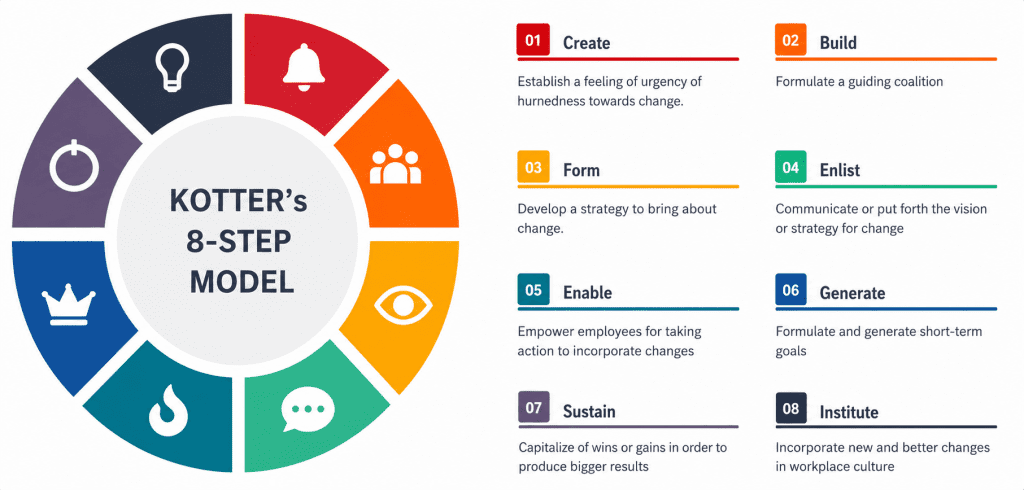
A major framework referenced during the webinar was Kotter’s Change Management Model.
Raphaella explained that four specific principles heavily influenced her leadership approach:
- Direction
- Purpose
- Agency
- Trust
These principles became foundational to how her team approached organizational transformation.
1) Direction
Teams need clarity around:
- institutional priorities
- strategic goals
- expected outcomes
- and operational focus.
Without direction, staff often default to reactive work instead of meaningful progress.
2) Purpose
People need to understand how their work contributes to something larger than themselves.
This creates stronger engagement and ownership.
3) Agency
Staff must feel empowered to contribute ideas, influence outcomes, and participate in institutional decision-making.
4) Trust
Transformation cannot happen without psychological safety.
Trust enables:
- collaboration
- innovation
- difficult conversations
- and healthy accountability.
“That’s how you start to get alignment — people feeling psychologically safe.”
— Raphaella Prange, Vice President for Student Affairs at Maryville University of Saint Louis
The webinar repeatedly returned to the idea that organizational transformation is fundamentally human work, not just operational work.
From Silos to Shared Ownership: Rethinking Budgeting and Collaboration
One of the most practical discussions during the webinar centered around zero-based collective budgeting.
Rather than automatically rolling over previous budgets, teams collectively reviewed expenditures and evaluated how each investment aligned with:
- student success
- institutional priorities
- and strategic goals.
Initially, the process felt overwhelming.
But over time, it created stronger cross-functional understanding and collaboration.
“When folks started sharing resources, I knew that we had won the zero-based budgeting battle.”
— Raphaella Prange, Vice President for Student Affairs at Maryville University of Saint Louis
The process also exposed a larger issue within many institutions:
People often inherit operational habits without fully understanding:
- budget structures
- resource allocation
- or the strategic reasoning behind institutional spending.
By making budgeting more collaborative and transparent, leadership teams developed:
- stronger financial literacy
- deeper institutional awareness
- and greater collective ownership.
Why Professional Development Is a Student Success Strategy
Raphaella strongly emphasized that professional development should not be viewed as optional.
Leadership growth directly impacts:
- staff engagement
- institutional culture
- and ultimately student success.
But she also challenged institutions to rethink what professional development actually means.
Rather than relying solely on large conferences, she advocated for:
- certifications
- skills-based learning
- AI literacy
- badging programs
- and targeted competency development.
“Professional development isn’t just about professional skills. It’s about motivation, productivity, and bringing someone joy.”
— Raphaella Prange, Vice President for Student Affairs at Maryville University of Saint Louis
Her leadership philosophy, which she refers to as “Up and Out,” focuses on helping team members grow into future leadership opportunities beyond their current roles.
“I’m not doing my job unless the team that reports to me is moving up and out.”
— Raphaella Prange, Vice President for Student Affairs at Maryville University of Saint Louis
This mindset reframes leadership development as a responsibility rather than a retention strategy.
AI, Curiosity, and the Future of Higher Education Leadership
The webinar also explored how AI is reshaping higher education leadership and student affairs operations.
Maryville University has already begun experimenting with:
- AI certifications
- prompt engineering training
- AI literacy development
- and visual intelligence systems designed to better understand student behavior and engagement patterns.
Raphaella emphasized that AI adoption is not about replacing human relationships.
It is about helping institutions:
- become more proactive
- improve operational efficiency
- and better support students at scale.
Brandon reinforced that higher education leaders must remain curious and open to experimentation.
“The world will move around without you.”
— Raphaella Prange, Vice President for Student Affairs at Maryville University of Saint Louis
The conversation highlighted a critical mindset shift:
Institutions do not need to fully master every new technology immediately.
But they do need to engage with change instead of resisting it.
“Up and Out”: Developing Leaders Who Grow Beyond Your Institution
One of the most memorable parts of the discussion was Raphaella’s philosophy around leadership growth.
Rather than viewing staff mobility as a loss, she views it as part of successful leadership development.
Her goal is not simply to retain employees indefinitely.
It is to:
- help people grow
- expand their capabilities
- and prepare them for larger opportunities.
“You can teach a lot of the skills-based stuff. But you can’t teach someone how to be a good human.”
— Raphaella Prange, Vice President for Student Affairs at Maryville University of Saint Louis
She emphasized the importance of hiring:
- good humans
- strategic thinkers
- growth-minded professionals
- and people willing to embrace change.
The conversation ultimately reframed leadership not as control, but as stewardship.
Key Takeaways for Higher Education Leaders
1️⃣ Start with listening before leading
Transformation begins with understanding institutional realities.
2️⃣ Strategic plans must remain active
A strategic plan only matters if teams operationalize it consistently.
3️⃣ Trust drives innovation
Psychological safety enables stronger collaboration and decision-making.
4️⃣ Professional development is infrastructure
Leadership growth directly impacts institutional performance.
5️⃣ AI readiness requires curiosity
Institutions do not need all the answers immediately, but they do need engagement and experimentation.
6️⃣ Student success starts with staff support
Strong student experiences depend on engaged and empowered teams.
Resources Mentioned During the Webinar
📘 Kotter’s Principles to Power Lasting Change
During the webinar, Raphaella Prange referenced Kotter’s change management principles as a foundational framework for building aligned, high-functioning leadership teams.
Topics include:
- Direction
- Purpose
- Agency
- Trust
- Leadership alignment
- Organizational change principles
Download the Framework
Preview the Framework
Kotter Change Management Framework
🤖 YOU.com AI Mastery Certifications
A three-level AI certification program focused on:
- prompting
- AI workflows
- agent creation
- and foundational AI literacy skills.
Closing Thought
Organizational transformation in higher education is rarely just about systems or strategy.
It is about people.
The institutions that move forward successfully will likely be the ones that:
- build trust internally
- create alignment across teams
- empower staff
- remain curious
- and continuously adapt to change.
Because in the end, leadership culture shapes student outcomes more than most institutions realize.
“The only folks that are going to make a difference are those leaders that are really impacting student success.”
— Raphaella Prange, Vice President for Student Affairs at Maryville University of Saint Louis
FAQs
Book a Personalized Demo
See how WriteSea helps institutions:
- improve career readiness
- scale student engagement
- enhance workforce preparation
- and better measure student outcomes.
Want to Go Deeper?
📩 Subscribe to The Write Way Newsletter
Stay ahead with weekly insights on AI, workforce readiness, student success, and higher education innovation.
🎓 Explore WriteSea for Higher Education
Learn how WriteSea helps institutions prepare students, scale support, strengthen career readiness, and measure outcomes across the student lifecycle.
📊 See How Institutions Are Creating Workforce-Ready Graduates Through AI and Experiential Learning
Explore how colleges and universities are helping students gain hands-on experience, build career-ready skills, and connect learning to employment outcomes.
🔗 Connect with Raphaella Prange, Vice President for Student Affairs (Maryville University of Saint Louis)
Learn from her 27 years of leadership experience across student affairs, institutional strategy, and organizational transformation.
🔗 Connect with Brandon Mitchell on LinkedIn
Learn more about career readiness, AI-powered student success, and workforce development in higher education.
▶️ Watch Our Previous Webinar: Beyond Appointments: Using Content to Expand Career Center Access and Impact
Learn from the discussion focused on building scalable, relatable career content ecosystems without increasing workload.
Join The Write Way Newsletter
Gain access to a wealth of industry insights, news updates, and exclusive executive interviews from top leaders in the higher education and online recruitment marketplace industry.

 From the blog
The New Rules of Career Readiness in an AI Economy
Read the article
Hiring OS SoonConnect ready students with partner employers.
 From the blog
Why Every University Needs an Employability Strategy, Not Just a Career Center
Read the article