Introduction
Higher education is being asked to answer increasingly difficult questions.
What is the value of a degree in a rapidly changing workforce? How should universities respond as artificial intelligence changes the skills employers need? How can institutions prepare students for careers without reducing education to job training? And how do colleges and universities evolve without losing the identity and purpose that made them valuable in the first place?
These questions may feel uniquely modern, but the principles behind them are not.
For
Moravian University, founded in 1742, the idea that education should respond to the needs of society stretches back centuries.
Bryon is a 1990 Moravian alumnus who returned to lead his alma mater in 2013. During his tenure, Moravian has transitioned from Moravian College to Moravian University, expanded its professional and graduate education, increased its investment in technology and AI, and grown full-time enrollment by 51% since 2014. This fall, Moravian welcomed an official first-year census class of 541 students against a goal of 530—the largest entering class in the university’s history.
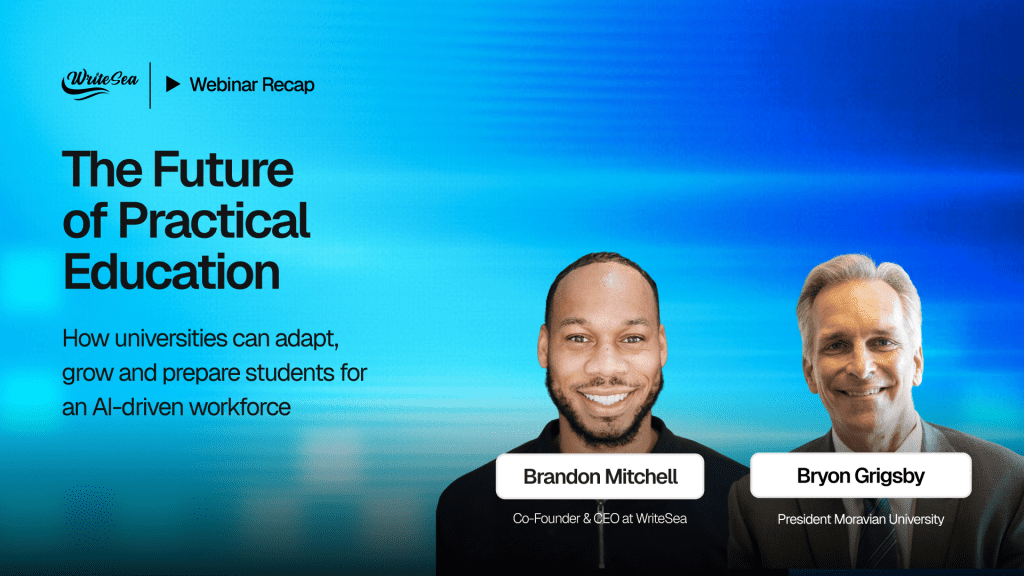
Throughout the conversation, Bryon and Brandon explored what practical education means today, how universities can respond to local workforce needs, why career readiness needs to begin earlier in the student experience, and what institutions must consider as AI reshapes education and work.
One idea connected much of the discussion:
“Education should concern itself with that which concerns society.”
For Moravian, that centuries-old principle continues to influence how the institution thinks about everything from healthcare and aviation to career readiness, credentials and artificial intelligence.
🎥 Missed it live?
Watch the recording .
Meet the Experts
🔹 Dr. Bryon Grigsby — President, Moravian University
Dr. Bryon Grigsby is President of Moravian University and a 1990 Moravian alumnus who returned to lead his alma mater in 2013.
During his tenure, Moravian has undergone significant growth and transformation, including its transition from Moravian College to Moravian University, the expansion of professional and graduate education, and increased investment in technology and AI. Full-time enrollment has grown 51% since 2014.
Bryon is leading Moravian’s continued focus on practical education and preparing students for a rapidly changing workforce.
Bryon is a 1990 Moravian alumnus who returned to lead his alma mater in 2013. During his tenure, Moravian has transitioned from Moravian College to Moravian University, expanded its professional and graduate education, increased its investment in technology and AI, and grown full-time enrollment by 51% since 2014. This fall, Moravian welcomed an official first-year census class of 541 students against a goal of 530—the largest entering class in the university’s history.
🔹 Brandon Mitchell — Co-Founder and CEO, WriteSea
Brandon Mitchell is a technology entrepreneur, executive coach and investor focused on helping colleges and universities strengthen student outcomes through connected career readiness infrastructure.
Before founding WriteSea, Brandon worked in technology consulting at PwC, where he advised Fortune 500 companies on complex technology challenges. His experience spans technology, SaaS, leadership, career development and organizational strategy.
As host of the webinar, Brandon brought the conversation back to a central question facing institutions today: how can higher education evolve alongside the workforce while continuing to deliver meaningful educational value?
Practical Education Is Not the Opposite of the Liberal Arts
The conversation began not with AI or careers, but with history.
Moravian’s educational roots stretch back to the thinking of John Amos Comenius, the 17th-century Moravian bishop widely regarded as an important figure in the development of modern education.
Bryon explained that Comenius believed everyone should be educated, including women and girls, and that education should be active, practical and connected to society.
When Moravians established missionary communities, Bryon explained, they would first establish a school for girls and then a school for boys. The reasoning was strikingly progressive for the 18th century: they believed an educated society depended on educating women.
That history continues to influence how Moravian thinks about education today.
It also challenges a common assumption about practical education: that institutions must choose between career preparation and the liberal arts.
Bryon rejected that distinction.
“The liberal arts have always been practical.”
Throughout history, he argued, the liberal arts have prepared people to participate meaningfully in the societies and economies of their time.
Today, the emphasis may be less on mastering an ever-expanding body of content and more on developing transferable capabilities: critical thinking, leadership, communication, teamwork, and quantitative and qualitative analysis.
“We have a responsibility to effectively train our students to be powerful in the world they’re going into.”
Practical education, then, does not require abandoning the liberal arts. It requires connecting those capabilities more deliberately to the world students are preparing to enter.
As Bryon summarized:
Start With the Problems Your Community Needs to Solve
One of the clearest lessons from Moravian’s approach to institutional growth is that program strategy does not necessarily begin with following national trends.
It can begin locally.
“Where there’s pain points in society, there’s an educational answer to that pain point.”
Bryon described how Moravian has used regional needs to inform its academic expansion.
When he returned to the university, Moravian had a nursing program but saw significant unmet healthcare workforce needs throughout the region. The university subsequently expanded into areas including occupational therapy, speech pathology, physical therapy and athletic training.
The same approach has informed newer programs.
Moravian identified regional demand for pilots, air traffic controllers and airport managers and launched an aviation program in an area without another local university offering one. On the day of the webinar, Bryon shared that Moravian students had taken their first flights as pilots.
Construction management emerged through a similar process. Major investments were entering the region, while conversations with local construction leaders revealed a need for trained construction managers. Moravian began developing a program in response.
The takeaway for other institutions is not to replicate Moravian’s programs. It is to understand their own communities.
“You have to do your SWOT analysis for your area.”
That requires institutional leaders to maintain relationships beyond campus.
Bryon spoke about attending Chamber of Commerce meetings, serving on boards, listening to CEOs and remaining close enough to the community to recognize emerging needs.
“Whenever you hear a pain point, your ears should be perking right up.”
Moravian has spent years building toward what Bryon described as “owning our backyard”: becoming an institution local organizations think of when they identify an education or workforce challenge they need help solving.
For universities thinking about enrollment, workforce development and program growth, that shifts the question from What program should we launch next? to What does our region need, and where is our institution positioned to respond?
Put Career Readiness at the Front End of the Student Experience
That same practical philosophy has shaped how Moravian approaches career readiness.
Bryon described an institutional analysis that uncovered an important disconnect: students and parents believed Moravian provided a level of career support that, at the time, the institution was not actually providing.
The findings became a wake-up call.
Moravian responded by significantly increasing resources for career services and moving career support toward the beginning of the student journey.
“We put career services at the front end.”
Rather than waiting for students to seek help close to graduation, career professionals begin connecting with students as they enter the university.
Students complete assessments designed to help identify their skills, strengths and potential career directions. Bryon described the career counselor as a concierge who can become a consistent point of connection, helping students navigate questions and directing them to the appropriate resources across the institution.
Moravian also incorporated NACE competencies and badging into its approach to career preparation.
And the institution has attached a tangible commitment to that work.
Bryon explained that students who complete the requirements of Moravian’s career promise—including NACE badging and an experiential component such as an internship, research or clinical experience—and still do not secure employment can receive six months of student loan payments from the university.
The conversation also raised a larger question for higher education:
Why is academic advising typically expected throughout a student’s education while career advising often remains optional?
Bryon suggested that career advising may represent another stage in the professionalization of student support—and that AI will increasingly become part of that evolution.
For institutions, the broader lesson is clear: career readiness becomes far more powerful when it begins before students urgently need a job.
Faculty Need Greater Visibility Into Where Education Leads
Connecting education to careers also requires faculty participation.
That can be particularly challenging within liberal arts disciplines, where the connection between a major and a specific occupation is often less obvious than it is in nursing, teaching or other professionally aligned programs.
Bryon argued that this does not mean faculty should become career counselors.
Instead, institutions can help faculty better understand the range of places their graduates go.
An English graduate, for example, may enter law, marketing, recruiting, communications, business or numerous other fields. Yet a faculty member whose own path moved from an English degree to a PhD and academia may have had limited exposure to those alternatives.
Bryon offered an interesting idea:
“One of the best things you could possibly do is have the liberal arts faculty do internships in businesses, so they actually know what their graduates go and do.”
Brandon added another example: faculty champions who test new approaches to career-connected learning and help bring those practices into the classroom.
The goal is not to turn faculty into career services professionals.
It is to give them greater visibility into the workforce their students will enter so they can help students recognize how academic skills translate into professional possibilities.
AI Literacy Is Becoming Part of Career Readiness
The conversation then moved to one of the largest forces reshaping both education and employment: artificial intelligence.
Bryon challenged a common assumption that younger students are automatically technologically proficient.
Students may be comfortable with technology without necessarily understanding how to use emerging tools critically, effectively or professionally.
That distinction matters as AI becomes more deeply embedded in the workplace.
Moravian has responded by investing in AI literacy and creating opportunities for students to experiment with emerging technologies, including through an AI Innovation Lab where students can build AI agents.
Bryon framed the current moment as another major technological transition.
“I don’t think it’s a question of, should we do this or not do this? I think it’s a question of, we have to do this.”
But adoption does not mean uncritical adoption.
The goal is to help students understand how to use AI effectively and responsibly while developing the judgment required to recognize its limitations and risks.
Brandon connected the shift to previous generations of workplace technology. Microsoft Word and Excel eventually became baseline professional capabilities. AI tools may increasingly occupy a similar place.
If that happens, AI literacy will not sit separately from career readiness.
It will become part of what being career-ready means.
Responsible AI Adoption Requires More Than Access to Tools
The audience Q&A pushed the conversation further, raising questions about privacy, institutional data, environmental concerns, ethics and resistance to generative AI.
Bryon acknowledged those concerns rather than treating AI adoption as a purely technological decision.
Moravian established an AI task force, which ultimately recommended dedicated institutional leadership around AI. The university was able to appoint someone internally whose background in social work also brings ethical considerations directly into the institution’s AI work.
Data protection presents another challenge.
As institutions experiment with AI, leaders need to understand what happens to institutional information when faculty, staff and students use external tools, and how enterprise environments differ from consumer versions.
Faculty autonomy also remains part of Moravian’s approach. A faculty member can decide that AI will not be used within a particular course, even as students encounter the technology elsewhere in their education.
The objective is therefore not simply maximum AI adoption.
It is AI literacy: giving students enough exposure, context and critical understanding to make informed decisions about the technology.
Bryon also emphasized that leaders themselves need to participate in that experimentation.
He shared that he spent part of the previous spring building an agentic AI system to support his cabinet work.
His reasoning was straightforward:
“If I say it’s good enough for the faculty, and the faculty should do this, I should do it too.”
AI strategy becomes more meaningful when leaders understand the technology through use rather than approaching it only through policy.
Skills and Experience Are Becoming More Important Signals
The rise of AI also raises a larger question: what will students need to demonstrate to employers?
For Bryon, the answer begins with skills.
“Skills are the only game. Skills and experience.”
As AI makes information increasingly accessible, the ability to apply knowledge, demonstrate competencies and show meaningful experience becomes even more important.
That is also shaping how Moravian thinks about credentials.
The university has developed AI certificates that can stack into its MBA, allowing learners to begin with a smaller credential and potentially continue toward a full degree.
Bryon sees promise in that model because the certificate exists within a broader educational pathway rather than as an isolated credential.
At the same time, he acknowledged a continuing challenge between higher education and employers: organizations do not always clearly articulate the skills they need, while universities may struggle to translate employer needs into curriculum without access to company-specific knowledge, processes and data.
The opportunity for higher education is significant.
Universities already have educators, learning infrastructure, technology and experience designing education. But they must remain close enough to employers to understand how skills are changing.
Bryon described the larger risk plainly:
“If we don’t become the key holders for AI education, someone else will.”
Higher Education Has Been Here Before
One of the most memorable moments of the webinar came near the end, when Bryon returned to Comenius.
The technological revolution Comenius embraced in the 17th century was very different from artificial intelligence.
It was the use of pictures in books.
At the time, illustrating educational texts was itself a significant innovation. Bryon also pointed to historical resistance to the printing press as another reminder that disruptive technologies often encounter skepticism before becoming ordinary.
The comparison was not intended to dismiss legitimate concerns about AI.
Bryon acknowledged that technological change is difficult and that institutions should appreciate why people are struggling with it.
But history offers perspective.
“This is the churn of change, and it’s hard.”
Universities have navigated technological, economic and social transformations before.
The challenge now is to engage seriously with the next one.
Your Action Plan: 5 Ways to Get Started
Scaling career readiness is a long-term institutional effort, but colleges and universities do not need to transform everything at once. The webinar offered several practical places to begin.
The webinar offered several practical starting points for institutional leaders.
1. Identify the Pain Points in Your Own Region
Conduct a serious assessment of local workforce needs. Talk with employers, chambers, boards, workforce organizations and community leaders.
Instead of simply asking which programs are growing nationally, ask where your own community has unmet needs and where your institution is positioned to respond.
2. Move Career Readiness Toward the Beginning of the Student Journey
Do not wait until students are approaching graduation.
Introduce career professionals, skills assessments, competencies, experiential learning and career pathways early enough for students to use that information to shape their educational experience.
3. Bring Faculty Closer to the Workforce
Help faculty understand where graduates actually go and how the skills taught within their disciplines translate across occupations.
Employer engagement, faculty internships or externships, faculty champions and stronger collaboration with career teams can help bridge that gap.
4. Build AI Literacy Through Responsible Experimentation
Give students, faculty and institutional leaders opportunities to understand and use AI rather than treating AI strategy purely as a policy exercise.
At the same time, establish appropriate conversations and safeguards around ethics, privacy, security, data and responsible use.
5. Help Students Demonstrate Skills and Experience
Degrees remain important, but students increasingly need evidence of what they can do.
Connect academic learning with competencies, badges, stackable credentials, internships, research, clinical experiences and other forms of applied learning that allow students to demonstrate their capabilities.
Closing Thought
Practical education is not a single program, credential or career initiative.
It is a way of thinking about the relationship between an institution and the society it serves.
It means listening when communities identify workforce needs. It means helping students understand how their education translates into skills and opportunities. It means bringing academic learning and career preparation closer together. And increasingly, it means preparing students to navigate technologies that will shape how they learn and work.
Moravian’s approach is rooted in a centuries-old educational philosophy, but its application is distinctly modern.
“Education should concern itself with that which concerns society.”
That may be one of the most useful principles for institutions navigating the uncertainty ahead.
Universities do not have to choose between preserving their educational purpose and responding to a changing world.
The opportunity is to do both.
Book a Personalized Demo
See how WriteSea helps institutions:
- Scale career support across the student population
- Improve student engagement and career readiness
- Deliver AI-powered résumé, cover letter and mock interview support
- Connect career development with experiential learning and employment outcomes
- Strengthen follow-up and first-destination data collection
Want to Go Deeper?
📩 Subscribe to The Write Way Newsletter
Stay ahead with weekly insights on AI, career readiness, student success and higher education innovation.
👉🏽 Subscribe here.
🎓 Explore WriteSea for Higher Education
Learn how WriteSea helps institutions scale support, strengthen career readiness and better measure outcomes across the student lifecycle.
👉🏽 Learn more.
🔗 Connect with Dr. Bryon Grigsby
Follow
Bryon and Moravian University’s work around practical education, institutional innovation, AI and preparing students for a changing workforce.
🔗 Connect with Brandon Mitchell
Follow
Brandon for insights on career readiness, AI-powered student success and the future of work in higher education.
▶️ Watch Our Previous Webinar
In the previous webinar, Brandon Mitchell, Co-Founder and CEO of WriteSea, and Shawndra Harmond, Vice President of Strategic Partnerships and Workforce Engagement at WriteSea, discussed how institutions can move career readiness beyond the career center and make it a shared, campus-wide responsibility.
Their conversation covered leadership buy-in, faculty engagement, cross-campus collaboration, technology, data and how institutions can embed career development throughout the student experience.
Join The Write Way Newsletter
Gain access to a wealth of industry insights, news updates, and exclusive executive interviews from top leaders in the higher education and online recruitment marketplace industry.