Introduction
Artificial intelligence is rapidly reshaping the workforce.
Students are learning AI, machine learning, and generative AI at an unprecedented pace through coursework, certifications, personal projects, and independent exploration. But while access to AI knowledge is growing, many institutions are still grappling with an important question:
How do we create meaningful opportunities for students to apply these skills in real-world settings before they graduate?
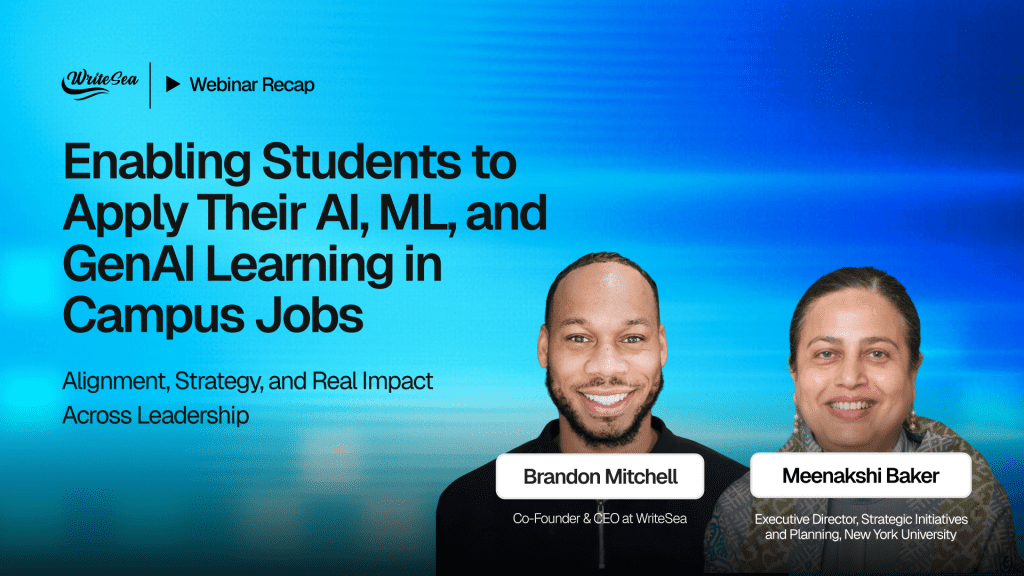
In this edition of The Write Way Webinar Series, Brandon Mitchell, Co-Founder & CEO of WriteSea, sat down with Meenakshi Baker, Executive Director of Strategic Initiatives and Planning at NYU IT, to discuss how higher education institutions can bridge the gap between AI learning and workforce readiness.
Drawing from her experience leading AI initiatives and student skilling programs at New York University, Meenakshi shared practical strategies for creating long-term pathways that help students gain hands-on experience, build professional confidence, and develop the skills employers increasingly expect.
As Brandon noted during the discussion, learning is important—but experience is what builds confidence, develops professional judgment, and prepares students for success in a rapidly changing workforce.
🎥
Missed it live? Watch the recording .
📄 Download Meenakshi Baker’s presentation slides here.
Meet the Experts
🔹 Meenakshi Baker — Executive Director, Strategic Initiatives and Planning, NYU IT
Meenakshi Baker is the Executive Director of Strategic Initiatives and Planning at New York University (NYU) Information Technology. She has extensive experience leading initiatives across higher education, with expertise in strategic planning, data governance, organizational development, and technology-enabled transformation.
Throughout her career, she has focused on creating innovative programs that support student success, workforce readiness, and experiential learning. Meenakshi holds master’s degrees from New York University and the Indian Institute of Technology (IIT) Kanpur.
She is passionate about helping institutions create meaningful opportunities for students to apply AI, machine learning, and generative AI skills in real-world settings.
🔹 Brandon Mitchell — Co-Founder & CEO, WriteSea
Brandon Mitchell is a technology entrepreneur, executive coach, and investor, dedicated to revolutionizing the career services and recruitment industry. As the Co-Founder & CEO of WriteSea, he is driving innovation in AI-powered career mobility solutions, helping job seekers and employers connect more effectively.
With a background in technology consulting at PricewaterhouseCoopers (PwC), Brandon has advised Fortune 500 companies, including KKR, Deutsche Bank, and Morgan Stanley, on complex technology and wealth management solutions. His expertise spans SaaS sales, executive leadership, and public speaking.
Brandon has been featured in Forbes, Yahoo Finance, Earn Your Leisure, and Black Wealth Renaissance. He is also a passionate advocate for financial literacy, career development, and generational wealth, frequently speaking on these topics.
He holds a degree in Finance, Economics, and Management Information Systems from SUNY Plattsburgh and is certified in project management and agile methodologies.
Why AI Learning Alone Is No Longer Enough
Across higher education, students are investing significant time learning AI tools and technologies.
But employers are increasingly looking beyond knowledge alone.
They want candidates who can demonstrate how they have applied those skills to solve problems, collaborate with stakeholders, manage projects, and deliver results.
This is where many students face a challenge.
While classroom instruction provides foundational knowledge, opportunities to apply that knowledge in authentic professional environments remain limited.
According to Meenakshi, institutions must begin thinking beyond AI education and focus on creating pathways that allow students to build experience alongside technical competency.
“Focus should always be on developing people’s skills.”
— Meenakshi Baker, Executive Director, Strategic Initiatives and Planning, NYU IT
The goal is not simply to teach students how AI works.
The goal is to help them learn how to use it effectively, responsibly, and professionally.
The Workforce Readiness Challenge Facing Higher Education
Higher education is currently facing a convergence of workforce, enrollment, and employability pressures.
Students and families are placing greater emphasis on career outcomes.
Employers are raising expectations.
And institutions are being asked to demonstrate stronger workforce readiness results.
At the same time, AI is transforming the nature of entry-level work.
Many routine and repetitive tasks are becoming automated, which means graduates must increasingly demonstrate higher-level skills from the beginning of their careers.
Students today want:
- Workplace readiness
- Portfolio-based learning
- Technical and business experience
- Faster access to targeted employment opportunities
Yet many still struggle to gain the practical experience needed to stand out in a competitive hiring market.
“Consistency and long term are really the key words here.”
— Meenakshi Baker, Executive Director, Strategic Initiatives and Planning, NYU IT
Short-term experiences have value, but sustained opportunities to practice, build, and refine skills over time are often what create meaningful career readiness outcomes.
Campus Employment as a Real-World AI Learning Environment
One of the most compelling ideas discussed during the webinar was the untapped potential of campus employment.
Many institutions already employ students across campus.
Students work in libraries.
Student affairs offices.
Technology departments.
Career centers.
Administrative units.
However, many of these positions remain disconnected from the skills students are developing in the classroom.
Meenakshi challenged institutions to think differently.
Rather than viewing campus jobs solely as operational support, institutions can begin viewing them as workforce development opportunities.
When AI-related projects are integrated into student employment, students gain opportunities to develop:
- Technical expertise
- Professional communication skills
- Project management experience
- Stakeholder engagement skills
- Real-world problem-solving capabilities
These experiences help students move beyond theory and begin building portfolios that demonstrate genuine capability.
Creating Continuous AI Skilling Pathways
A major theme throughout the discussion was the importance of creating continuous learning pathways rather than isolated experiences.
At NYU, AI skilling initiatives are designed to support ongoing growth and progression.
Students continue building skills over time rather than restarting with each new semester.
This approach creates stronger outcomes for both students and institutions.
Students develop deeper expertise.
Institutions build stronger talent pipelines.
And employers gain access to graduates who can demonstrate meaningful experience rather than theoretical knowledge alone.
The focus is not simply participation.
The focus is progression.
From Capstone Projects to Career Readiness
One of the most practical frameworks shared during the webinar was NYU’s progression model.
Students often begin by participating in capstone projects connected to real institutional challenges.
Unlike traditional academic exercises, these projects are tied to actual stakeholder needs and organizational priorities.
Students receive:
- Structured mentorship
- Milestone reviews
- Stakeholder engagement opportunities
- Real-world project experience
High-performing students may then move into paid student worker roles where they continue building their technical and professional skills.
Some graduates continue contributing through alumni opportunities before transitioning into full-time positions within higher education or industry.
The pathway creates a structured progression:
Capstone Project → Student Worker → Alumni Opportunity → Full-Time Employment
This approach helps students develop both technical expertise and professional readiness while creating long-term value for the institution.
Make It a Sequence, Not a Campaign
One of the most memorable lessons from the webinar centered on how institutions should approach change.
Rather than attempting to launch large-scale initiatives all at once, Meenakshi encouraged leaders to focus on building momentum through small, credible successes.
“Make it work as a sequence, not a campaign.”
— Meenakshi Baker, Executive Director, Strategic Initiatives and Planning, NYU IT
This means:
- Starting with pilot projects
- Demonstrating value
- Building trust
- Creating evidence of success
- Expanding over time
Small wins often create the foundation for larger institutional transformation.
By focusing on manageable steps, institutions can build support while reducing resistance and risk.
Building Support Across Faculty, Students, and Administrators
Throughout the webinar, Meenakshi repeatedly emphasized the importance of collaboration.
Successful initiatives rarely begin with technology.
They begin with people.
Faculty understand learning outcomes.
Students understand their own challenges and aspirations.
Administrators understand institutional priorities and operational realities.
Bringing these groups together creates stronger programs and more sustainable outcomes.
“The school runs because of students and faculty. We just enable the learning.”
— Meenakshi Baker, Executive Director, Strategic Initiatives and Planning, NYU IT
Rather than attempting to gain support from an entire institution immediately, leaders can start by identifying willing partners and building momentum through meaningful collaboration.
Balancing Innovation with Data Governance
Questions about privacy, governance, and security naturally emerge whenever institutions begin exploring AI initiatives.
This topic surfaced during the webinar’s Q&A session.
Meenakshi emphasized the importance of partnering closely with institutional leaders responsible for data governance and security.
At NYU, students initially work with synthetic data rather than sensitive institutional information.
Access expands only after training, demonstrated competency, and appropriate approvals.
This approach allows institutions to:
- Build skills safely
- Protect sensitive information
- Establish responsible AI practices
- Reduce risk while encouraging innovation
The conversation reinforced an important point:
Innovation and governance are not competing priorities. Strong governance enables responsible innovation.
Key Takeaways for Higher Education Leaders
1️⃣ Identify a real institutional challenge
Look for opportunities where students can contribute meaningful value while developing AI-related skills.
2️⃣ Start small
Launch pilot programs and proof-of-concepts before pursuing large-scale initiatives.
3️⃣ Partner with faculty and students
Build programs around existing expertise, interests, and institutional needs.
4️⃣ Create progression pathways
Think beyond internships and create opportunities for continuous learning and development.
5️⃣ Involve governance teams early
Collaborate with IT, security, and data leaders from the beginning to ensure responsible implementation.
Closing Thought
The future of workforce readiness will not be defined solely by what students know.
It will increasingly be defined by what students can demonstrate.
As AI continues transforming industries and reshaping workforce expectations, institutions have an opportunity to create learning experiences that move beyond theory and into practice.
The institutions that succeed will be those that create pathways for students to build experience, develop confidence, and apply their skills in meaningful ways long before graduation.
Because ultimately, career readiness is not built through knowledge alone.
It is built through experience.
Resources Mentioned During the Webinar
📄 Meenakshi Baker’s Presentation Slides
During the webinar, Meenakshi Baker shared her framework for helping institutions create meaningful pathways for students to apply AI, machine learning, and generative AI skills through campus employment and experiential learning opportunities.
The presentation explores:
- The workforce readiness challenges facing higher education
- The growing demand for hands-on AI experience
- Campus employment as an AI skilling strategy
- The Capstone → Student Worker → Alumni → Full-Time Employment pathway
- The “Make It a Sequence, Not a Campaign” framework
- AI governance and responsible implementation practices
👉🏽 Download the presentation slides here.
Book a Personalized Demo
See how WriteSea helps institutions:
- improve career readiness
- scale student engagement
- enhance workforce preparation
- and better measure student outcomes.
Want to Go Deeper?
📩 Subscribe to The Write Way Newsletter
Stay ahead with weekly insights on AI, workforce readiness, student success, and higher education innovation.
🎓 Explore WriteSea for Higher Education
Learn how WriteSea helps institutions prepare students, scale support, strengthen career readiness, and measure outcomes across the student lifecycle.
📊 See How Institutions Are Creating Workforce-Ready Graduates Through AI and Experiential Learning
Explore how colleges and universities are helping students gain hands-on experience, build career-ready skills, and connect learning to employment outcomes.
🔗 Connect with Meenakshi Baker on LinkedIn
Explore her work in AI, workforce development, student employment, and institutional innovation.
🔗 Connect with Brandon Mitchell on LinkedIn
Learn more about career readiness, AI-powered student success, and workforce development in higher education.
▶️ Watch Our Previous Webinar: Creating High-Functioning Senior Teams in Higher Education: Leadership Alignment, Trust, and Organizational Transformation
Learn how higher education leaders can build stronger leadership alignment, create cultures of trust, improve collaboration, and drive organizational transformation that supports student success.
Join The Write Way Newsletter
Gain access to a wealth of industry insights, news updates, and exclusive executive interviews from top leaders in the higher education and online recruitment marketplace industry.
 From the blog
The New Rules of Career Readiness in an AI Economy
Read the article
Hiring OS SoonConnect ready students with partner employers.
 From the blog
Why Every University Needs an Employability Strategy, Not Just a Career Center
Read the article